






Region:
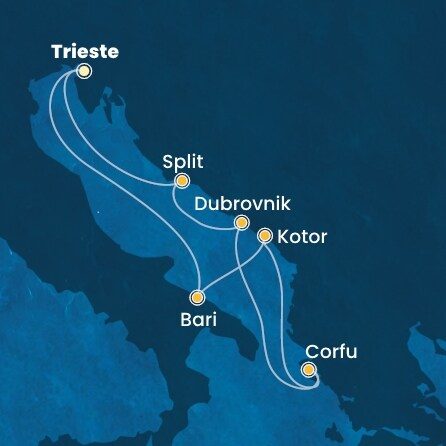
Route:
Company:
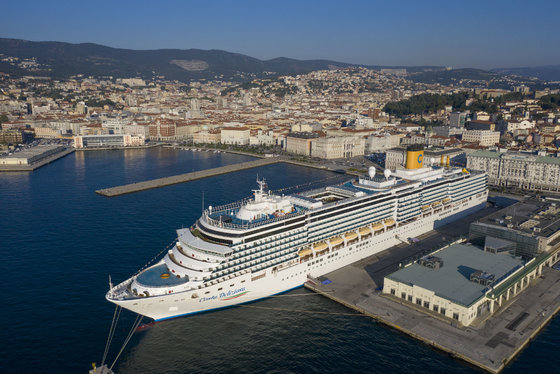
Ship:
od
1 099 €/os.
Itinerary
| DAY | Port / Program | ARRIVAL | DEPARTURE |
|---|---|---|---|
| 1. | 1. Trieste / Italy (embarkation) | --:-- | 17:00 |
| 2. | 2. Bari / Italy | 14:00 | 20:00 |
| 3. | 3. Kotor / Montenegro | 08:00 | 17:00 |
| 4. | 4. Corfu / Greece | 09:00 | 19:00 |
| 5. | 5. Relaxing day at sea | --:-- | --:-- |
| 6. | 6. Dubrovnik / Croatia | 08:00 | 18:00 |
| 7. | 7. Split / Croatia | 08:00 | 17:00 |
| 8. | 8. Trieste / Italy (disembarkation) | 09:00 | --:-- |
In the destination
On board
-
day-by-day itinerary1. dayTrieste / Italy (embarkation) / Trieste, a port located on the border between Italy and Slovenia, has been a crossroads since its inception, where the influences of the West, East, and North have met. The most significant chapter of its history was written from the 19th century until the end of World War I, when it was the most important port of Austria-Hungary. The character of the city is complemented by the proximity of several world-famous attractions, such as the famous Lipica Stud Farm or the vast Škocjan Caves. Among the significant landmarks is also the Miramare Castle, which was the residence of Archduke Maximilian of Habsburg, the younger brother of Emperor Franz Joseph I.
-
day-by-day itinerary2. dayBari / Italy / Bari is a significant port, an industrial center, and at the same time one of the most important pilgrimage sites in Italy. The relics of St. Nicholas attract pilgrims and tourists from all over the world. In the vicinity of Bari, there are also three exceptional sites from the UNESCO World Heritage list. These include Alberobello, with its unique architecture of houses called "trulli," which has no equivalent in the world, or the rock city of Sassi in Matera, known for its prehistoric settlement. The last unique site is the mysterious octagonal castle Castel del Monte from the 12th century, whose function has not yet been clarified.
-
day-by-day itinerary3. dayKotor / Montenegro / The port of Kotor is one of the best-preserved medieval towns in southeastern Europe. Hidden at the very end of the natural bay of Boka Kotorska, it is called the "pearl of the Adriatic" and for its preserved fortification system and medieval center, it has been listed as a UNESCO World Heritage Site. Don't miss the breathtaking view of the bay from the fortress of St. John, which towers above the town, the Romanesque Cathedral of St. Tryphon, or the preserved walls including gates, and join us on a trip to Kotor!
-
day-by-day itinerary4. dayCorfu / Greece / Corfu, traditionally identified with the mythical island of the Phaeacians, is among the most famous and touristically visited Greek islands. It is located in the Ionian Sea and is characterized by a diverse natural landscape, rich vegetation, and cultural-historical heritage. The main city of Kerkyra, with its two fortresses and preserved historic center, is listed as a UNESCO World Heritage Site. Significant landmarks also include the Achillion Palace, built in the 19th century for the Austrian Empress Elisabeth (Sissi). The island is further known for its beaches, village architecture, monasteries, and natural scenery, which together create the distinctive character of this locality.
-
day-by-day itinerary6. dayDubrovnik / Croatia / Dubrovnik is rightly called the "pearl of Dalmatia." It is among the most valuable historical complexes in southeastern Europe and is undoubtedly the most famous Croatian resort. The port city with a rich history offers a unique mix of various attractions, which led to its inclusion on the UNESCO World Heritage list in 1979. Its beautiful center with perfectly preserved fortifications, Gothic churches and palaces, and narrow streets full of restaurants and shops, all attract visitors from around the world who come to admire this preserved medieval city.
-
day-by-day itinerary7. daySplit / Croatia / An important port and cultural center of the Dalmatian coast. This is Split, a city of great historical significance. This former residence of the Roman Emperor Diocletian today offers uniquely preserved remains of the imperial palace, which are listed as a UNESCO World Heritage Site, or the Cathedral of St. Domnius located on the site of the original emperor's mausoleum. In close proximity to Split lies the island town of Trogir, a Dalmatian jewel and another part of the UNESCO cultural heritage, which, with its winding streets and Venetian palaces, is one of the best-preserved medieval towns on the Adriatic coast.
-
day-by-day itinerary8. dayTrieste / Italy (disembarkation) / Trieste, a port located on the border between Italy and Slovenia, has been a crossroads since its inception, where the influences of the West, East, and North have met. The most significant chapter of its history was written from the 19th century until the end of World War I, when it was the most important port of Austria-Hungary. The character of the city is complemented by the proximity of several world-famous attractions, such as the famous Lipica Stud Farm or the vast Škocjan Caves. Among the significant landmarks is also the Miramare Castle, which was the residence of Archduke Maximilian of Habsburg, the younger brother of Emperor Franz Joseph I.