


Split / Croatia
Split, the second largest city in Croatia, is situated on the picturesque coast of the Adriatic Sea and is one of the most important centers of all Dalmatia. It offers a unique blend of ancient history, Mediterranean atmosphere, and modern lifestyle. Surrounded by mountains and the sea, it has a unique appearance and attracts travelers seeking both cultural experiences and relaxation by the water or in nature. The very center grew on the foundations of the former imperial palace, the remains of which today form the historical core of the city – this unique cultural heritage was inscribed on the UNESCO World Heritage List in 1979. It consists of a maze of stone alleys where you can find cafes, shops with local products, galleries, and small markets. Although Split is visited by thousands of tourists every year, it does not lose its natural atmosphere and friendly character. The city has excellent transport accessibility – by air, rail, and sea – and also serves as an excellent starting point for exploring the surrounding islands.
The history of Split dates back to Roman times, specifically to the turn of the 3rd and 4th centuries AD. It was then that Emperor Diocletian had a monumental palace built, which was to serve as a place for peaceful rest after his abdication. The building was designed not only as a residence but also as a fortified complex with administrative and economic functions. After the fall of the Roman Empire, inhabitants from nearby Salona, the then capital of the province of Dalmatia, began to arrive here, and the palace naturally transformed into a lively urban environment. Its original structure has been preserved to this day and forms the basis of today's center. In the Middle Ages, Split belonged to the Venetian Republic, later to the Habsburg Monarchy, which left a mark on local architecture and culture. The city experienced periods of prosperity and decline, but thanks to its strategic location, it always maintained an important role in the region, not only commercially and politically but also culturally.
Split can enchant visitors at first sight – with its unique combination of history, seaside atmosphere, and lively daily rhythm. Just walk through the stone alleys of the historic center, and one feels like they have stepped back centuries. Visitors can admire ancient walls, medieval palaces, and romantic squares that today pulse with life – you will find cozy cafes, galleries, markets, and street artists here. Split will also be loved by those seeking peace and relaxation – perhaps at sunset on the Riva promenade, swimming at city beaches, or enjoying the view from the top of Marjan hill. The city also offers a variety of cultural events, festivals, and nightlife, which has a relaxed yet energetic vibe. Experiences from Split are diverse – from quiet moments in a stone alley to bustling evenings under the open sky. And it is this diversity that makes Split a place that is unforgettable and where one wants to return.
Local Specialties:
The gastronomy of Split is typical of the Mediterranean style, which emphasizes fresh and quality ingredients. The local cuisine is dominated by fish, seafood, olive oil, vegetables, and herbs. Dishes are prepared simply but with an emphasis on taste and tradition, often according to recipes passed down through generations. Dining in this area is strongly linked to lifestyle – food is not just a necessity but also an opportunity for meeting and relaxation. Split offers a wide range of restaurants where you can enjoy authentic Dalmatian specialties and modern interpretations of traditional dishes.
- Pašticada – slowly stewed beef in a sweet and sour sauce with wine, served with homemade gnocchi
- Brudet (brodet) – fish stew with tomatoes, onions, and wine, often served with polenta
- Černé rizoto (Crni rižot) – risotto made from squid or cuttlefish, colored with cuttlefish ink
- Grilled fish – most often sea bream, mackerel, or sea bass, served with blitva (Swiss chard and potatoes)
- Soparnik – traditional baked pie filled with Swiss chard, onions, and garlic
- Pršut and sheep cheese – dried ham and cheese served as an appetizer, often with olives
- Peka – meat (e.g., lamb or octopus) with vegetables prepared under a bell on hot coals
- Rakija – fruit brandy, most often made from grapes, plums, or figs
- Dalmatian wines – among the most famous are Plavac mali, Pošip, or Vugava
- Fritule – small fried balls similar to doughnuts, often served at celebrations
General Information:
- Official language: Croatian, but in tourist areas, you can also communicate in English, German, or Italian
- Currency: Euro (EUR)
- Opening hours: Shops are usually open from Monday to Friday between 8:00 and 20:00. On Saturdays, they are open until 14:00 or 15:00, and on Sundays, they are often closed or have limited hours. Restaurants and cafes are open from 10:00 until late in the evening. Monuments and museums are usually accessible from 9:00 to 17:00, longer during the summer season.
- Public transport: Public transport in Split is provided by the bus company Promet Split, which operates a dense network of lines connecting the center with individual districts and the surrounding area. Tickets can be purchased at kiosks, machines, or directly from the driver (with a surcharge). The main bus and train stations are located right next to the port, making it easy to transfer between different modes of transport.
- Weather: Split has a Mediterranean climate, with hot and dry summers (28-35 °C) and mild winters (10-15 °C), occasionally accompanied by rain. The main tourist season in Split lasts from May to September, with the peak season in July and August.
Places Worth Seeing:
- Diocletian's Palace
- Cathedral of St. Domnius (sv. Duje)
- People's Square (Narodni trg)
- Seaside promenade Riva (Obala hrvatskog narodnog preporoda)
- Marjan Hill
- Bačvice or Kašjuni Beach
- Split City Museum
- Trogir
Port map:
Places worth seeing:

Peristil je hlavní náměstí Diokleciánova paláce, které sloužilo jako císařské ceremoniální nádvoří. Obklopují ho sloupořadí a významné stavby jako katedrála sv. Domnia, původně Diokleciánovo mauzoleum. Ke katedrále přiléhá ikonická zvonice (bell tower), která je dominantou Splitu a nabízí nádherný výhled na město. Na náměstí se nachází také Jupiterův chrám, dnes kaple sv. Jana Křtitele. Peristil je oblíbeným místem setkávání a kulturních akcí. Je považován za jedno z nejkrásnějších antických nádvoří v Evropě.

Diokleciánův palác je jednou z nejzachovalejších staveb římské architektury na světě a nachází se v chorvatském Splitu. Byl postaven na přelomu 3. a 4. století jako rezidence římského císaře Diokleciána. Palác je zapsán na Seznamu světového dědictví UNESCO a tvoří historické jádro města Split. Mezi nejzajímavější části patří Zlatá brána, slavnostní nádvoří Peristyl, Jupiterův chrám a původní císařovo mauzoleum, dnes katedrála sv. Domnia.

Jupiterův chrám ve Splitu je malý, ale architektonicky cenný římský chrám zasvěcený původně bohu Jupiterovi. Nachází se v blízkosti Peristilu a pochází ze 3. století, stejně jako celý Diokleciánův palác. V 11. století byl přeměněn na křesťanskou kapli sv. Jana Křtitele. Před vchodem do chrámu stojí originální egyptská sfinga z černé žuly, kterou sem přivezl sám císař Dioklecián. Sfinga je více než 3 000 let stará a patří k nejzajímavějším artefaktům v paláci.


Getting to the port:
Ships are docked at the Port of Split at New Split Berth for Cruising Ships, located at Obala kneza Domagoja 16, 21000, Split, Croatia. Upon arrival at the port, the ship will already be visible, but any signs will guide you in the right direction.
Cruises from Split:

Croatia, Italy from Split na lodi MSC Armonia
| Ship: | MSC Armonia |
|---|---|
| Route: | Croatia, Italy |
| Embarkation: | Split, Croatia |
| Disembarkation: | Marghera (Venice), Italy |
| Duration: | 1 noc (1) |
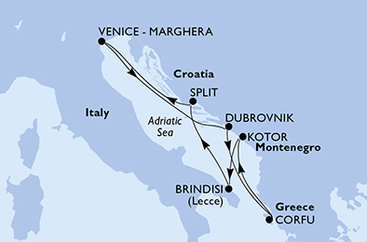
Croatia, Italy, Greece, Montenegro from Split na lodi MSC Armonia
| Ship: | MSC Armonia |
|---|---|
| Route: | Croatia, Italy, Greece, Montenegro |
| Embarkation and disembarkation: | Split, Croatia |
| Duration: | 7 nights |

Croatia, Italy, Greece, Egypt from Split na lodi MSC Lirica
| Ship: | MSC Lirica |
|---|---|
| Route: | Croatia, Italy, Greece, Egypt |
| Embarkation and disembarkation: | Split, Croatia |
| Duration: | 10 nights |
Cruises to Split:

Italy, Croatia from Bari na lodi MSC Lirica
| Ship: | MSC Lirica |
|---|---|
| Route: | Italy, Croatia |
| Embarkation: | Bari, Italy |
| Disembarkation: | Marghera (Venice), Italy |
| Duration: | 2 noci (2-4) |
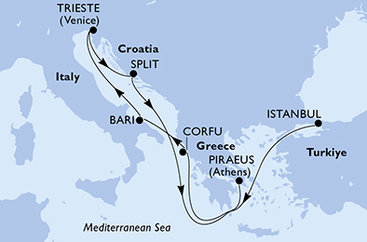
Turkey, Greece, Italy, Croatia from Istanbul na lodi MSC Seaview
| Ship: | MSC Seaview |
|---|---|
| Route: | Turkey, Greece, Italy, Croatia |
| Embarkation: | Istanbul, Turkey |
| Disembarkation: | Piraeus (Athens), Greece |
| Duration: | 7 nights |

Italy, Greece, Egypt, Croatia from Marghera (Venice) na lodi MSC Lirica
| Ship: | MSC Lirica |
|---|---|
| Route: | Italy, Greece, Egypt, Croatia |
| Embarkation and disembarkation: | Marghera (Venice), Italy |
| Duration: | 10 nights |