


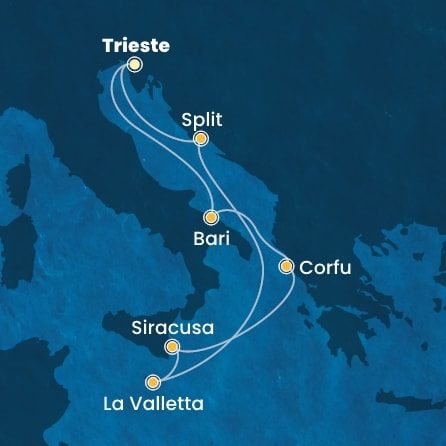




Route:
Company:
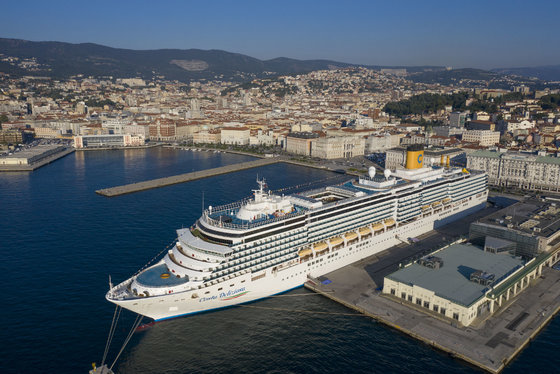
Ship:
od
859 €/os.
Itinerary
| DAY | Port / Program | ARRIVAL | DEPARTURE |
|---|---|---|---|
| 1. | 1. Trieste / Italy (embarkation) | --:-- | 17:00 |
| 2. | 2. Bari / Italy | 14:00 | 20:00 |
| 3. | 3. Corfu / Greece | 09:00 | 16:00 |
| 4. | 4. Syracuse (Sicily) / Italy | 10:00 | 20:00 |
| 5. | 5. Valletta / Malta | 08:00 | 18:00 |
| 6. | 6. Relaxing day at sea | --:-- | --:-- |
| 7. | 7. Split / Croatia | 08:00 | 17:00 |
| 8. | 8. Trieste / Italy (disembarkation) | 09:00 | --:-- |
In the destination
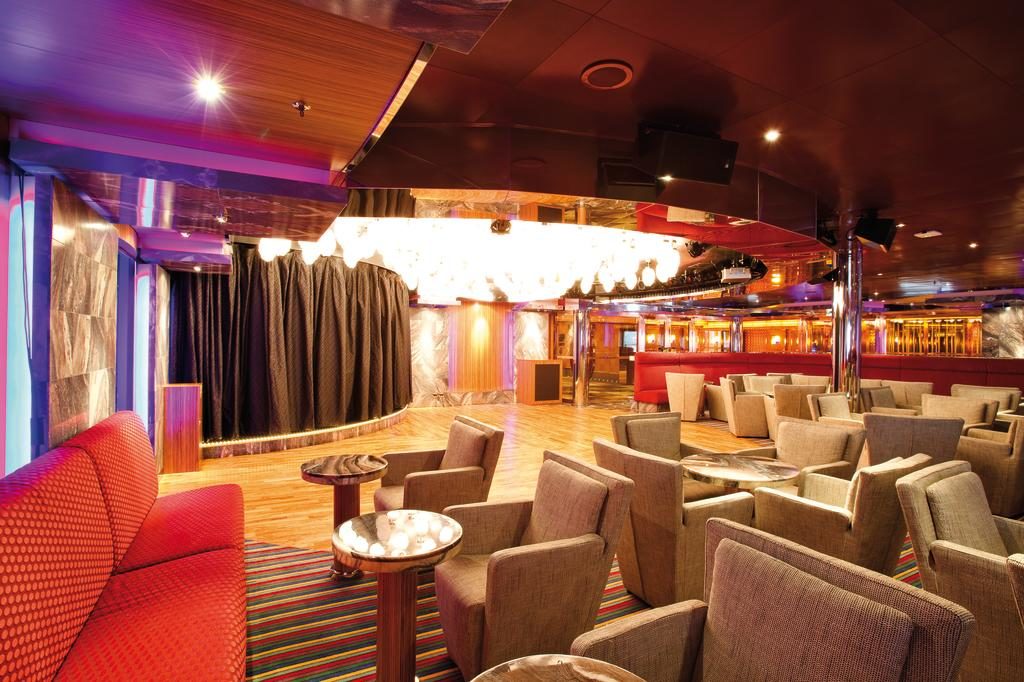
On board
-
day-by-day itinerary1. dayTrieste / Italy (embarkation) / Trieste, a port located on the border between Italy and Slovenia, has been a crossroads since its inception, where the influences of the West, East, and North have met. The most significant chapter of its history was written from the 19th century until the end of World War I, when it was the most important port of Austria-Hungary. The character of the city is complemented by the proximity of several world-famous attractions, such as the famous Lipica Stud Farm or the vast Škocjan Caves. Among the significant landmarks is also the Miramare Castle, which was the residence of Archduke Maximilian of Habsburg, the younger brother of Emperor Franz Joseph I.
-
day-by-day itinerary2. dayBari / Italy / Bari is a significant port, an industrial center, and at the same time one of the most important pilgrimage sites in Italy. The relics of St. Nicholas attract pilgrims and tourists from all over the world. In the vicinity of Bari, there are also three exceptional sites from the UNESCO World Heritage list. These include Alberobello, with its unique architecture of houses called "trulli," which has no equivalent in the world, or the rock city of Sassi in Matera, known for its prehistoric settlement. The last unique site is the mysterious octagonal castle Castel del Monte from the 12th century, whose function has not yet been clarified.
-
day-by-day itinerary3. dayCorfu / Greece / Corfu, traditionally identified with the mythical island of the Phaeacians, is among the most famous and touristically visited Greek islands. It is located in the Ionian Sea and is characterized by a diverse natural landscape, rich vegetation, and cultural-historical heritage. The main city of Kerkyra, with its two fortresses and preserved historic center, is listed as a UNESCO World Heritage Site. Significant landmarks also include the Achillion Palace, built in the 19th century for the Austrian Empress Elisabeth (Sissi). The island is further known for its beaches, village architecture, monasteries, and natural scenery, which together create the distinctive character of this locality.
-
day-by-day itinerary4. daySyracuse (Sicily) / Italy / Syracuse, a historic city in southeastern Sicily, preserves a wealth of cultures dating back to the Bronze Age and boasts a UNESCO World Heritage listing. The ancient Greek theater, the oldest Jewish ritual baths, and the rock necropolis from the Bronze Age represent fascinating testimonies of the past. Overlooking the city is a medieval fortress and a 7th-century cathedral, offering panoramic views of the surroundings. Syracuse is also associated with great figures of science and art, such as Archimedes and Leonardo da Vinci. The nature reserve of the Cassibile River canyon near the city complements the image of Sicily as a place where history, culture, and nature blend into a unique experience.
-
day-by-day itinerary5. dayValletta / Malta / Valletta is a city that will captivate every lover of history and Mediterranean atmosphere. Monumental walls, narrow streets, grand palaces, and views of the Grand Harbour create a backdrop that is hard to find elsewhere in the Mediterranean. Add to that UNESCO sites, the knightly history of the Order of Malta, cozy cafes, and the proximity of picturesque towns, and you'll understand why Valletta is one of the most popular stops for Mediterranean cruises. You can also combine your visit with a trip to the medieval Mdina, the viewpoints of the Three Cities, or swimming in the crystal-clear waters of the Maltese coast.
-
day-by-day itinerary7. daySplit / Croatia / An important port and cultural center of the Dalmatian coast. This is Split, a city of great historical significance. This former residence of the Roman Emperor Diocletian today offers uniquely preserved remains of the imperial palace, which are listed as a UNESCO World Heritage Site, or the Cathedral of St. Domnius located on the site of the original emperor's mausoleum. In close proximity to Split lies the island town of Trogir, a Dalmatian jewel and another part of the UNESCO cultural heritage, which, with its winding streets and Venetian palaces, is one of the best-preserved medieval towns on the Adriatic coast.
-
day-by-day itinerary8. dayTrieste / Italy (disembarkation) / Trieste, a port located on the border between Italy and Slovenia, has been a crossroads since its inception, where the influences of the West, East, and North have met. The most significant chapter of its history was written from the 19th century until the end of World War I, when it was the most important port of Austria-Hungary. The character of the city is complemented by the proximity of several world-famous attractions, such as the famous Lipica Stud Farm or the vast Škocjan Caves. Among the significant landmarks is also the Miramare Castle, which was the residence of Archduke Maximilian of Habsburg, the younger brother of Emperor Franz Joseph I.