


Ceuta / Spain
Ceuta is a unique Spanish city on the northern coast of Africa, washed by the waters of the Mediterranean Sea. It fascinates with its blend of European elegance and exotic African charm, rich history, and vibrant culture. Thanks to its strategic location by the Mediterranean Sea and regular ferry connection with the city of Algeciras on the Spanish coast, Ceuta represents an ideal place for exploring history, culture, and seaside life.
What to taste in Ceuta?
The gastronomy of Ceuta is diverse and significantly influenced by Mediterranean and North African cuisine.
- Pescaito frito – crispy fried small fish, typical for the coastal area.
- Couscous – fine couscous with meat and vegetables, a popular Moroccan specialty.
- Pinchos morunos – spiced lamb or chicken skewers, ideal as a quick snack while walking around the city.
- Tortas de aceite – thin olive cakes with a slightly sweet taste, great for afternoon tea.
- Churros con chocolate – a sweet treat typical for Spanish breakfasts and cafes.
Why will you love Ceuta?
- A city at the crossroads of continents – the lively historic center of the medina with cafes, narrow streets, and squares will draw you into the pulsating life of Ceuta. Royal walls, Monte Hacho fortress, and St. Mary of the Assumption Cathedral then remind of the fascinating history of the city and its strategic importance at the border of Europe and Africa.
- Natural scenery and beaches – promenades with views of the Mediterranean Sea, quiet bays like Playa de la Ribera, and scenic hills offer places for relaxation, photography, and romantic walks at sunset.
- Vibrant cultural atmosphere – traditional markets, festivals, and local music complement visits to landmarks, such as the Parque Marítimo del Mediterráneo complex and the historic medina district, which combine historical heritage with the modern life of the inhabitants.
Practical tips:
- Official language: Spanish, but English is commonly spoken.
- Currency: Euro (EUR).
- Opening hours: Shops are usually open from 10:00 to 21:00, with a lunch break between 14:00 and 17:00. Museums and landmarks are usually open between 9:30 and 18:00.
- Public transport: Ceuta offers a reliable bus network, with the historic center being compact and easily walkable. For shorter transfers, taxis can be used. The ferry to the Spanish port of Algeciras provides a convenient connection to the mainland part of Spain.
- Weather: Ceuta has a typical Mediterranean climate with hot, dry summers and mild winters. The main tourist season lasts from May to October, with average temperatures between 25–35 °C.
The most interesting from the history of Ceuta:
Ceuta was established as a port in a strategic location on the northern coast of Africa and quickly became an important point on Mediterranean trade routes. The area was originally settled by the Phoenicians, followed by the Carthaginians and later the Romans, who built the first fortresses and infrastructure here. In the Middle Ages, the city was under Portuguese and Spanish rule, which led to the expansion of fortifications and the construction of fortresses protecting its strategic port. For centuries, Ceuta was also a crossroads of cultures – Arab, Jewish, and Christian influences are reflected in its architecture, traditions, and everyday life. Ceuta thus still offers a unique blend of history, Mediterranean atmosphere, and cultures of Europe and Africa, creating a completely unique character of this city.
Useful information
Port map:
Places worth seeing:

Casa de los Dragones v Ceutě je ikonická stavba ve španělské enklávě na severním pobřeží Afriky s eklektickou architekturou. Budova je známá svými dekorativními draky na střeše, které jí daly jméno a činí z ní jedinečnou turistickou atrakci.

Mohutné kamenné hradební věže Murallas Reales v Ceutě se tyčí nad historickým centrem města a odrážejí se v klidném příkopu při soumraku, vytvářejíc malebnou atmosféru. Tyto hradby připomínají strategickou obranu města v průběhu staletí.

Královské hradby Ceuty tvoří impozantní opevnění ve španělské autonomní enklávě na severu Afriky. Jejich původ sahá až do roku 962 a dodnes připomínají strategický význam města v průběhu staletí.


Getting to the port:
Cruise ships dock at the Port of Ceuta located at Mlle. España, s/n, 51001 Ceuta, Spain. The city center is accessible on foot from the pier – the walk takes approximately 15 minutes along the coast. There is also a shuttle bus available, providing a convenient transfer directly to the center. For shorter distances or quick trips between beaches and landmarks, local taxi services can be used.
Cruises to Ceuta:
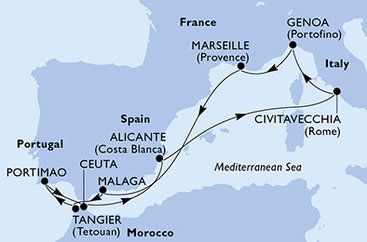
Italy, France, Spain, Morocco, Portugal from Civitavecchia (Rome) na lodi MSC Sinfonia
| Ship: | MSC Sinfonia |
|---|---|
| Route: | Italy, France, Spain, Morocco, Portugal |
| Embarkation and disembarkation: | Civitavecchia (Rome), Italy |
| Duration: | 10 nights |


