


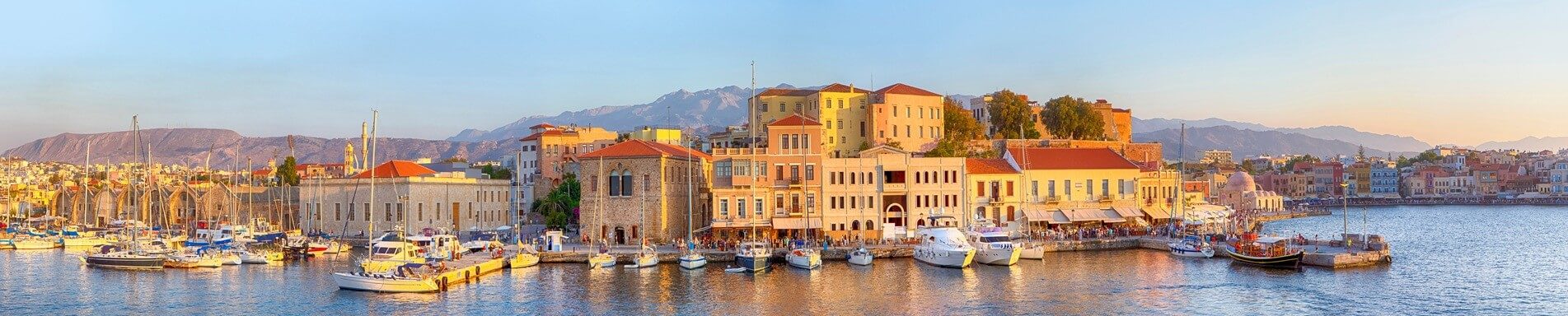
Chania (Crete) / Greece
Chania located on the northwest coast of Greek Crete is today with 66 thousand inhabitants the second largest city of the island (after Heraklion). It is a beautiful and romantic city that locals call “the beauty of the west”, as its architecture and atmosphere are unparalleled in Crete. Today it is a popular tourist destination, not only during cruises in the Mediterranean Sea. The historic center surrounded by 3 km long walls offers, alongside interesting churches, preserved shipyards, the Janissary Mosque, or Turkish baths. Chania also provides plenty of opportunities for relaxation, right outside the city walls there are pleasant beaches and hotel complexes.
What to taste in Chania?
In the Chania area on Crete, a wide range of traditional specialties is offered:
- Bougatsa Iordanis – pastry filled with sweet Myzithra cheese,
- Chaniotiko bouréki – zucchini pie with potatoes and Myzithra cheese,
- Ntákos – rusk with cheese, tomatoes, olive oil, and capers sprinkled with herbs,
- Loukoumades – fried balls in honey and cinnamon,
- Raki – traditional grape brandy.
Why will you love Chania?
Chania will win you over on your first walk through its narrow streets scented with the sea and spices. The Venetian harbor with its iconic lighthouse is charming during the day and transforms into a lively scene full of lights and a pleasant atmosphere in the evening.
In the surroundings, you will find turquoise lagoons, fine beaches, and impressive mountain scenery – an ideal combination for relaxation and adventure. And the local hospitality will quickly convince you that you are in the right place.
History lovers can visit Aptera, located about 13 km from Chania. It is an archaeological site, a city of Minoan and Greek culture, where according to legend, a contest between the Sirens and the Muses took place. Besides ancient excavations, there is also the Monastery of Saint John from the 12th century or the remains of a Turkish fortress.
Practical tips:
- Official language: Greek, but in tourist areas, you can also communicate in English.
- Currency: Euro (EUR).
- Opening hours: In Chania, they are usually similar to elsewhere in Greece, from 9:00 to 14:00, with a siesta break, and then again from 17:00 to 21:00, with Sunday usually closed. However, in summer and tourist locations, shops are open all day, including weekends.
- Public transport: It is mainly provided by buses, operated by the KTEL company, and tickets can be purchased directly from the driver. Another option is to use a taxi service or rent a car or scooter. From the Souda port, regular bus lines run towards the center and to the main bus station, from where it is a few minutes' walk to the old town, a faster and more convenient option is a taxi, which stands directly in front of the terminal.
- Weather: Chania has a typical Mediterranean climate with mild rainy winters (average 12 °C) and hot sunny summers (exceeding 30 °C). The main tourist season is from May to October.
The most interesting from the history of Chania:
The city was founded already in ancient times and according to legend, it was named Kydion, the grandson of King Minos. From the original fishing settlement, it quickly became a significant center, which also appears in Homer's Odyssey. During Roman rule, Kydonia became a major port, minting its own coins until the end of the 3rd century. The later period of alternating rule by Arabs and Byzantines is not well documented, but it is clear that the city was renamed Chania and fortified. After the 4th Crusade in 1204 and the collapse of the Byzantine Empire, Crete fell to the Venetians, who chose Chania as the seat of their governor. They brought their culture, Catholic faith, and architecture and built most of the preserved buildings. Chania remains one of the best-preserved Venetian cities in the Mediterranean, with original shipyards, palaces, and churches. During the Ottoman era (1645–19th century), most churches were converted into mosques, and many buildings acquired ornamental decoration. In the 19th century, the city was affected by uprisings against the Turks, which led to the annexation of Crete to the Greek Kingdom and the departure of the Muslim population. Chania then became the capital of Crete, until it was definitively annexed to Greece in 1913. In 1971, the main city administration was moved to Heraklion, yet it remained a significant tourist center with a modern airport and port.
Useful information
Port map:
Places worth seeing:

Pláž Marathi patří mezi oblíbené písečné pláže díky své mělké vodě a charakteristickému světle modrému odstínu.

Klášter Agia Triada, jeden z nejpozoruhodnějších řeckopravoslavných klášterů na Krétě, stojí na klidném poloostrově Akrotiri.

Slavná písečná pláž Falasarna na severozápadě Chanie.


Getting to the port:
Cruise ships dock at the Port of Souda located at: Ormos Soudas, Chania 731 34, Greece.