


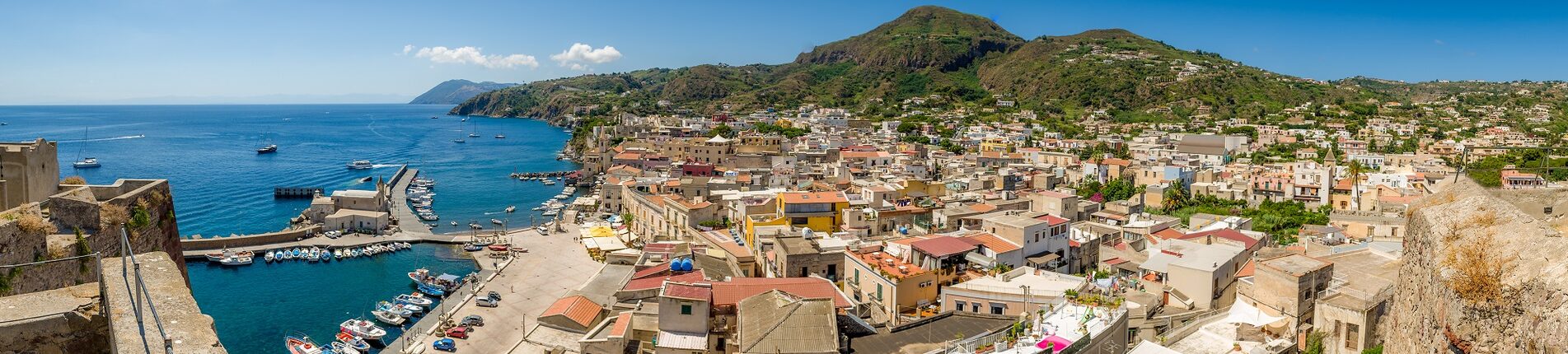
Lipari / Italy
Lipari, the largest of the Aeolian Islands near Sicily, is known for its volcanic landscape, rugged coastline, and rich history. In the town of the same name, the historic center with narrow streets and the Castello di Lipari fortress has been preserved, housing an archaeological museum. Besides historical monuments, the island also attracts visitors with its local beaches, boat trips, and traditional Sicilian cuisine.
What to taste in Lipari?
The local cuisine is based on Sicilian traditions and uses fresh fish, olive oil, capers, and other ingredients typical of the Aeolian Islands.
- Pane cunzato – traditional bread with olive oil, tomatoes, oregano, capers, and olives, sometimes complemented with cheese or fresh herbs.
- Pasta with capers and tomatoes – a Mediterranean specialty that combines the distinctive taste of local capers with tomatoes, olive oil, and aromatic herbs.
- Fresh fish and seafood – a popular part of the local cuisine includes swordfish and sardines, prepared on the grill or with lemon and herbs.
- Granita – an icy dessert from Sicily, often made from fruit and served with a sweet brioche.
- Malvasia delle Lipari – an aromatic wine from the Aeolian Islands, known especially for its sweet version made from dried grapes, which pairs well with desserts.
Why will you love Lipari?
- Volcanic landscape and beautiful views – the volcanic origin of the island is reminded by light pumice deposits and a rugged coastline. From the Belvedere Quattrocchi viewpoint, there is a view of the sea and the neighboring island of Vulcano.
- Rich history and significant monuments – the historic center is dominated by the fortified area of Castello di Lipari with an archaeological museum that preserves valuable finds from the Aeolian Islands. Also noteworthy are the San Bartolomeo Cathedral and the ancient cloister.
- Harbor atmosphere and Sicilian traditions – Marina Corta with fishing boats, cafes, and restaurants is a pleasant place to sit. The street Corso Vittorio Emanuele offers shops and the opportunity to taste local specialties, while from the harbor you can take a boat trip to the surrounding Aeolian Islands.
Practical tips:
- Official language: Italian, in tourist areas you can often communicate in English as well.
- Currency: euro (EUR).
- Opening hours: Shops are usually open during the day, some smaller establishments may have a lunch break. Restaurants typically serve lunch around noon and dinner in the late evening hours. The opening hours of monuments vary according to the season.
- Public transport: Buses connect the town of Lipari with other villages and selected beaches on the island. You can also use taxis or rent a scooter or car. The surrounding Aeolian Islands are accessible by regular boat connections.
- Weather: Lipari has a Mediterranean climate with hot, dry summers and mild, wetter winters. The main tourist season lasts approximately from May to October, when daily temperatures range roughly between 20 and 30 °C. In July and August, average daily highs reach approximately 27–28 °C, while in spring and autumn the weather is pleasant for exploring the island.
The most interesting from the history of Lipari:
The history of the island of Lipari dates back thousands of years and has been influenced by the volcanic environment from the beginning. Already in the Neolithic period, the island became famous for its obsidian, a dark volcanic glass that people used to make sharp tools. Thanks to its quality, Lipari became an important trading center, and obsidian was distributed from here to various parts of the Mediterranean. Later, the island was settled by Greek colonists and gradually became part of the Greek and Roman worlds. In the Middle Ages, it gained significance as a religious center, but its history was also marked by pirate raids. A crucial event was the year 1544 when the island was plundered by the Ottoman corsair Hayreddin Barbarossa, and many local inhabitants were taken into captivity. Today, the island's long history is not only reflected in its cultural heritage but also in its extraordinary volcanic landscape. Due to its geological value, the Aeolian Islands were inscribed on the UNESCO World Heritage List in 2000.
Useful information
Port map:
Places worth seeing:

Marina Corta je malebný přístav v historickém centru města Lipari, obklopený barevnými domy a restauracemi. Je oblíbeným místem pro posezení u moře i výlety lodí na okolní Eolské ostrovy.

Katedrála sv. Bartoloměje a pevnost Castello di Lipari, významné historické památky na ostrově Lipari.

Katedrála svatého Bartoloměje v historickém areálu Castello di Lipari.


Getting to the port:
On the island of Lipari, there are two harbors – Marina Lunga and Marina Corta. Cruise ships anchor at sea and passengers are transported to the mainland using smaller boats (tenders), which arrive at the Marina Lunga Pier, located approximately 1 km from the town center. Marina Corta is about 500 meters from the center, and its surroundings consist of a square with cafes and restaurants. In the harbor, you can also arrange boat trips to nearby beaches and other Aeolian Islands.
Cruises to Lipari:

Italy, France, Monaco, Spain from Civitavecchia (Rome) na lodi Explora I
| Ship: | Explora I |
|---|---|
| Route: | Italy, France, Monaco, Spain |
| Embarkation: | Civitavecchia (Rome), Italy |
| Disembarkation: | Barcelona, Spain |
| Duration: | 7 nights |
Spain, Italy, France, Monaco from Barcelona na lodi Explora I
| Ship: | Explora I |
|---|---|
| Route: | Spain, Italy, France, Monaco |
| Embarkation and disembarkation: | Barcelona, Spain |
| Duration: | 14 nights |


