

Brindisi / Italy
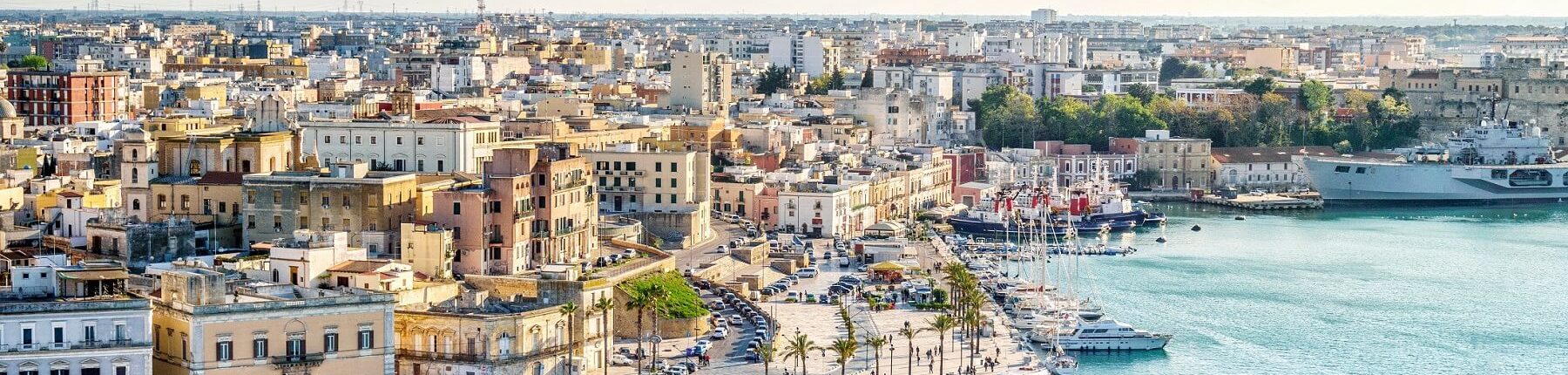
Brindisi, a port city in southeastern Italy in the picturesque region of Apulia, lies on the azure coast of the Adriatic Sea. Thanks to its protected harbor, which cuts deep into the mainland, it has been an important maritime hub connecting the Apennine Peninsula with the Eastern Mediterranean since antiquity. Today, Brindisi is a starting point for cruises to Greece, Albania, or the Ionian Islands, and cruise ships regularly call here during their Mediterranean circuits. Despite its significant transport function, the city does not feel busy or overcrowded. On the contrary – it retains a peaceful atmosphere and the natural charm of southern Italy. The historic center has preserved its traditional character, the locals are friendly and hospitable, and the overall impression is enhanced by an authentic environment untouched by mass tourism.
The history of Brindisi dates back to the period before the arrival of the Romans when the ancient Messapian nation lived here. In the 3rd century BC, the city became part of the Roman Empire and quickly gained importance due to its location at the end of the famous Via Appia. Ships sailed from Brindisi to Greece, Egypt, and the Holy Land, and the city became a gateway to the Orient. In the Roman era, it flourished as a commercial and military center, which is still reminded by preserved monuments. It also played a significant role in the Middle Ages when it became a starting point for crusades. Its rulers alternated – Byzantines, Normans, Hohenstaufens, and Aragonese left cultural and architectural heritage here. In the 19th century, Brindisi was a key stop on the British postal route to India, and during World War II, it even briefly served as the capital of Italy. Today, the city combines the tranquility of a small Mediterranean port with an impressive history that can be felt almost at every step.
Brindisi attracts its visitors not only with its location but also with its pleasant atmosphere. The waterfront lined with palm trees and cafes offers beautiful views of the sea and moored ships – ideal for evening walks. In the very center of the city, there are many interesting monuments and archaeological sites. The dominant feature of the historic core is the Romanesque Cathedral of St. John the Baptist from the 12th century, standing on the elegant Piazza Duomo surrounded by Gothic palaces. Among the main attractions are also the monumental Roman Harbor Steps (Scalinata Virgiliana), named after the famous poet Virgil, and the Roman Column, symbolizing the end of the famous Via Appia road – today one of the symbols of the city, towering above the sea promenade. On the coast stands the mighty Swabian Castle (Castello Svevo) from the time of Emperor Frederick II, and on the islet at the entrance to the harbor is the picturesque Castello Alfonsino, the so-called sea castle, which impressively rises from the sea surface. Under the Verdi Theater, there is an accessible archaeological site with a preserved part of a Roman street. In the Archaeological Museum of the province of Brindisi, rare collections from the Roman and Greek periods can be seen – including bronze statues, amphorae, and other maritime artifacts. North of the city, at Cape Punta Penne, there are nice sandy beaches, ideal for summer relaxation.
Brindisi is also an ideal base for trips to the surrounding countryside. Approximately an hour's drive from here lies the charming town of Alberobello, listed as a UNESCO World Heritage Site. It is known for its typical white houses with conical roofs, the so-called trulli, which create a unique scenery – a trip here feels like a journey into a fairy tale. Nearby is also the Baroque pearl of Apulia, the city of Lecce, often nicknamed "Florence of the South" due to its beautiful architecture, historic churches, and elegant squares. Another gem within reach is Ostuni, nicknamed the "White City" – it is situated on a hill, and its whitewashed houses contrast with the blue sky and the greenery of olive trees in the surroundings. This diversity of Apulia leaves a strong impression on visitors and often becomes one of the most beautiful memories of a trip to southern Italy.
Local Specialties:
The cuisine of Brindisi is based on traditional Apulian gastronomy, which emphasizes fresh, seasonal ingredients and simple yet tasty preparation. Thanks to its location by the sea, fish and seafood play a major role, often prepared on the grill or with pasta. Homemade olive oil, vegetables, and local wines also hold a significant place.
- Orecchiette con le cime di rapa – typical ear-shaped pasta served with turnip greens (broccoli), garlic, anchovy, and olive oil.
- Frittura di paranza – a fried mix of small sea fish and seafood, served with lemon.
- Cozze gratinate – baked mussels with garlic, breadcrumbs, parsley, and olive oil.
- Tiella di riso, patate e cozze – a layered dish of rice, potatoes, and mussels, typical for the Apulia region.
- Polpo alla pignata – octopus stewed in its own juice with tomatoes, potatoes, and herbs.
- Pittule – small fried buns made from leavened dough, often filled with olives, anchovies, or vegetables.
- Pasticiotto – sweet pastry filled with vanilla cream, popular especially for breakfast or with coffee.
- Negroamaro and Primitivo wine – two distinctive red wines from the region, ideal for Mediterranean cuisine.
General Information:
- Official Language: Italian, but in tourist areas, you can also communicate in English.
- Currency: Euro (EUR)
- Opening Hours: Shops are usually open from 9:00 to 20:00, often with a lunch break between 13:00 and 16:00, while supermarkets and shopping centers often operate without a lunch break until the evening. Restaurants typically open for lunch between 12:00 and 15:00 and for dinner from 19:00 to 23:00.
- Public Transport: Public transport in the city is provided by the STP Brindisi bus lines, which connect the center with the suburbs, the train station, and the port. Tickets can be purchased at newsstands, at the station, or through mobile apps. Brindisi also has good train connections with other cities in Apulia, such as Lecce or Bari, allowing easy trips to the wider surroundings.
- Weather: Brindisi has a Mediterranean climate, with mild winters and hot summers (28–32 °C). The most sunny days are from May to September, when the main tourist season also takes place.
Port map:
Places worth seeing:

Papežská bazilika a katedrála Navštívení Panny Marie a sv. Jana Křtitele (Pontificia Basilica Cattedrale della Visitazione e San Giovanni Battista) se nachází na náměstí Piazza Duomo v centru Brindisi. Byla postavena ve 12. století a představuje směs románské architektury s pozdějšími barokními úpravami. Katedrála slouží jako sídlo arcibiskupa a patří k nejvýznamnějším sakrálním stavbám ve městě.

Na nábřeží se nacházejí koncové sloupy slavné antické silnice Via Appia, která začíná v Římě a končí právě zde. Tato římská cesta byla jednou z nejvýznamnějších dopravních tepen římské říše, spojující centrum impéria s východními provinciemi. Z původních dvou monumentálních sloupů se dochoval jen jeden, druhý byl v 16. století přemístěn do města Lecce. Sloup v Brindisi se stal symbolem města a připomíná jeho někdejší roli brány do Orientu.

Kostel San Giovanni al Sepolcro v Brindisi je malý románský chrám z 11. století, který upoutá svou kruhovou architekturou inspirovanou chrámem Božího hrobu v Jeruzalémě. Sloužil poutníkům na cestě do Svaté země jako duchovní zastávka. Uvnitř se dochovaly původní fresky a kamenné reliéfy zobrazující biblické výjevy. Neobvyklý tvar stavby odráží symboliku věčného života a zároveň připomíná spojení Brindisi s křižáckými výpravami.


Getting to the port:
Ships dock at the Brindisi Cruise Terminal at Giovanna di Bulgaria, Viale Regina Margherita, 72100, Brindisi, Italy. Upon arrival at the port, the ship will already be visible, but any signs to each ship will guide you in the right direction.
Cruises from Brindisi:
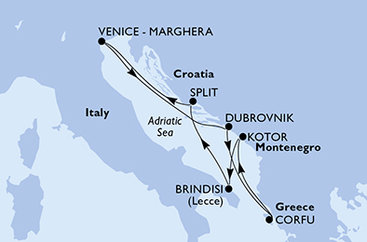
Italy, Croatia, Greece, Montenegro from Brindisi na lodi MSC Armonia
| Ship: | MSC Armonia |
|---|---|
| Route: | Italy, Croatia, Greece, Montenegro |
| Embarkation and disembarkation: | Brindisi, Italy |
| Duration: | 7 nights |
Cruises to Brindisi:
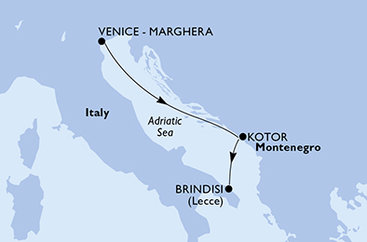
Italy, Montenegro from Marghera (Venice) na lodi MSC Armonia
| Ship: | MSC Armonia |
|---|---|
| Route: | Italy, Montenegro |
| Embarkation: | Marghera (Venice), Italy |
| Disembarkation: | Brindisi, Italy |
| Duration: | 3 nights |
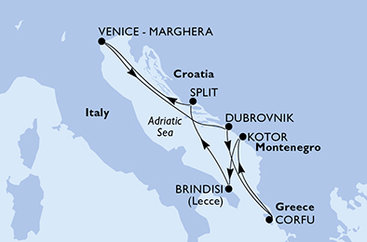
Italy, Croatia, Greece, Montenegro from Marghera (Venice) na lodi MSC Armonia
| Ship: | MSC Armonia |
|---|---|
| Route: | Italy, Croatia, Greece, Montenegro |
| Embarkation and disembarkation: | Marghera (Venice), Italy |
| Duration: | 7 nights |
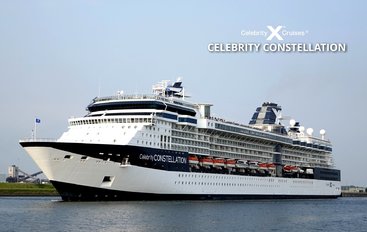
Italy, Croatia from Ravenna na lodi Celebrity Constellation
| Ship: | Celebrity Constellation |
|---|---|
| Route: | Italy, Croatia |
| Embarkation: | Ravenna, Italy |
| Disembarkation: | Civitavecchia (Rome), Italy |
| Duration: | 11 nights |