


Eilat / Israel
At the very south of Israel, between wild desert mountains and turquoise waters of the Red Sea, lies Eilat, a city where the desert meets the tropical underwater world. Colorful coral reefs, schools of exotic fish and crystal-clear sea invite diving and snorkeling, while the nearby Timna Park surprises with fantastic rock formations and traces of ancient civilizations. Among the biggest attractions is also the Underwater Observatory, from where you can observe life below the surface of the Red Sea, without getting wet. Thanks to its location between Israel, Jordan, and Egypt, Eilat is an exceptionally interesting stop on cruises on the Red and Arabian Sea, which combines the charm of exotic coastlines with desert adventures.
What to taste in Eilat?
The local gastronomy combines Israeli cuisine with Mediterranean and Middle Eastern influences. In restaurants, you will find fresh salads, grilled meat, fish, and quick street food.
- Hummus – a smooth chickpea spread with tahini, lemon, and olive oil, usually served with pita.
- Falafel – fried chickpea balls or patties, often in pita with vegetables and tahini.
- Shakshuka – eggs prepared in a spicy tomato sauce with peppers, especially popular for breakfast.
- Sabich – pita filled with fried eggplant, hard-boiled egg, salad, and sauces.
- Grilled fish – various types of fish are served on the coast with vegetables, lemon, and local spices.
- Malabi – chilled milk pudding with rose syrup, pistachios, or coconut.
Why will you love Eilat?
- The underwater world of the Red Sea – Coral reefs, clear water, and colorful fish create excellent conditions for snorkeling and observing marine life from the observatory.
- The desert at your fingertips – Just a short trip from the beaches takes you among colorful rocks, ancient mines, and unusual geological formations of Timna Park.
- Exceptional location – The view across the Gulf of Aqaba to the Jordanian mountains and the contrast of the sea with the surrounding desert give Eilat an atmosphere different from other Israeli cities.
Practical tips:
- Language: The official language is Hebrew; in tourist services, you can usually communicate in English. You will also often hear Arabic and Russian.
- Currency: Israeli New Shekel (ILS, NIS). Credit cards are common in hotels and restaurants; small cash is handy for smaller purchases.
- Opening hours: Shops and attractions have various operating hours. Important is the Sabbath, which lasts from Friday sunset to Saturday evening; some services and connections may be limited, while some tourist businesses remain open.
- Transport: Buses and taxis run around the city. For southern beaches and more distant attractions, a bus, taxi, or organized tour is practical. When arriving by cruise ship, it is necessary to respect the rules of the commercial port and verify the possibility of transfer.
- Weather: Eilat has a hot and very dry desert climate. In summer, temperatures often exceed 35°C and can rise above 40°C; a more pleasant time to explore the desert is in spring and autumn. Water, a head covering, and sun protection are essential.
The most interesting from the history of Eilat:
The area at the northern end of the Gulf of Aqaba was strategically important already in ancient times, as it connected trade routes from the Arabian Peninsula with the interior of the Levant. Biblical mentions of Eilat and Ezion-Geber relate to the area of the gulf, but the exact location of individual ancient settlements is the subject of historical research. In the vicinity of today's city, the influence of regional kingdoms and empires alternated in different periods; copper mining in the Timna area also played an important role. During the Ottoman rule, the southern coast of today's Israel remained a sparsely populated border area. Modern Eilat began to develop after 1949, when Israeli forces reached the coast of the Gulf of Aqaba during Operation Uvda. The city gained municipal status in 1959 and gradually transformed into a port and tourist center. A significant chapter in its modern history was the disputes over Israeli ships' access to the Strait of Tiran and the Red Sea; today, Eilat is known primarily as a seaside resort and gateway to the southern desert.
Useful information
Port map:
Places worth seeing:

Pobřeží Ejlatu omývají průzračné vody Akabského zálivu, nad nimiž se zvedají majestátní pouštní hory. Díky příjemnému klimatu a slunečnému počasí téměř po celý rok je město oblíbeným místem pro plachtění, vodní sporty i odpočinek u moře.

Podmořská observatoř v Ejlatu umožňuje pozorovat fascinující život korálových útesů Rudého moře přímo pod hladinou, aniž by se návštěvníci museli potápět. Součástí mořského parku jsou také akvária s tropickými rybami, žraloky a dalšími mořskými živočichy.

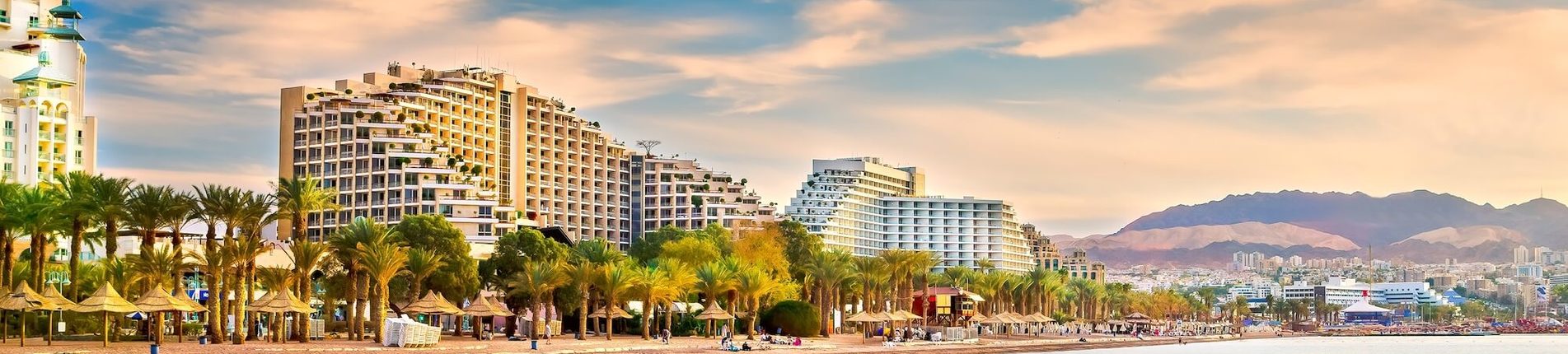
Z kamenného mola se otevírá krásný výhled na pobřeží Ejlatu s moderními hotelovými komplexy, písečnými plážemi a tyrkysovými vodami Akabského zálivu. Za slunečných dnů lze přes moře spatřit také jordánské pobřeží s městem Akaba., Middle East_2253534983


Getting to the port:
Cruise ships arrive at the Port of Eilat, which is located on the Red Sea coast approximately 5 km south of the city center. It is a commercial port with controlled access, so passengers follow the instructions of the port staff upon disembarking. To reach the center of Eilat and the main tourist attractions, one can take a taxi or an organized transfer by the shipping company. Nearby the port, there are also popular beaches and coral reefs.