


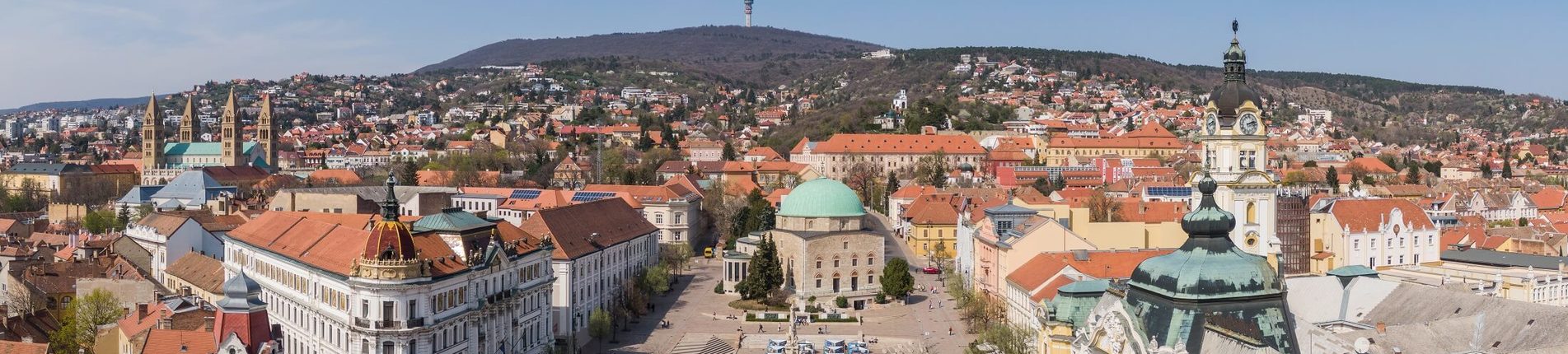
Pécs / Hungary
In southern Hungary, on the right bank of the Danube River, lies the town of Mohács, home to just under 20,000 inhabitants.
Already during the Roman Empire, there was a small settlement in the area of today's Mohács. In 1526, after the first battle of Mohács, the town was taken over by the Ottoman Empire, whose rule ended with the second battle of the same name in 1687. It is possible to remember it in a historical memorial with a wide collection of clothing, tools, and armor. Today, the small town is for most visitors the gateway to the city of Pécs (Five Churches), located 40 kilometers away, one of the largest and most beautiful cities in all of Hungary.
The city, home to about 150,000 inhabitants, was founded by the Romans in the 2nd century AD, and from this period, an extensive early Christian necropolis has been preserved, which was inscribed on the UNESCO list. The history of the beautiful Romanesque cathedral dates back to the 11th century, but there is no shortage of monuments from later periods: for example, the beautiful All Saints Church or the Carmelite and Franciscan monasteries date from the Baroque period.
The heart of Pécs is Széchenyi Square with a 17th-century mosque, which – although it is now used as a church – reminds of the 150-year Turkish rule. Another monument to the Ottoman Empire is the Jakowali Hassan Pasha Mosque with a 23-meter high minaret, which today hosts a museum dedicated to Turkish history and art.
The impressive barbican, a watchtower, is a remnant of the original city fortifications from the mid-13th century. In 1367, the university in Pécs was founded, making it one of the oldest in Europe. The fountain in the heart of Pécs commemorates the Zsolnay family ceramics and porcelain factory, which today serves as a cultural center and exhibition space. Those who wish can also look into the Zsolnay Mausoleum from 1900, the final resting place of the company's founder.
One of the symbols of the city is the 197-meter high TV tower on the Mecsek hill, from which there are beautiful views, and right below it is a zoo. (Not only) families will also enjoy the Aquarium and Terrarium, unusually located 10 meters underground in the spaces of medieval cellars.
Gourmets can look forward to spicy Hungarian goulash, chicken paprika, or traditional langos, and wine lovers will be in seventh heaven in Pécs: the city lies in a fertile area and is surrounded by vineyards as far as the eye can see.
Places worth seeing
Historical Memorial Park – In Mohács, remember the infamous battle of 1526, which marked the beginning of Ottoman rule in Hungary.
Széchenyi Square – Stroll through the central square of Pécs with a mosque that still reminds of the 150-year Turkish rule over the city.
Early Christian Necropolis – Admire the early Christian tombs, underground chambers built as early as the 4th century AD, inscribed on the UNESCO list.
Barbacan Tower – View the watchtower, a remnant of the original fortifications of Pécs from the mid-13th century.
Cathedral of Pécs – Visit the majestic, now Romanesque cathedral with a crypt, whose origins date back to the 11th century.
TV Tower – Climb to the observation deck of the 197-meter high TV tower and see the ancient city from a bird's eye view.
Zsolnay Museum – Discover the story of one of Hungary's most successful families against the backdrop of the country's historical events.
Victor Vasarely Museum – Don't miss a tour of the collection of works by Victor Vasarely, the founding father of the abstract art movement op art.