


Pointe-à-Pitre (Guadeloupe) / French Overseas Department
Guadeloupe, which is part of the Leeward Islands (Lesser Antilles), is a French overseas department. The main part of the territory consists of the islands of Basse-Terre and Grande-Terre, which are separated only by the salty Salée River. Each of these islands, however, has a different character and surface. The eastern island of Grande-Terre is rather flat, more populated, and is home to the largest city, Pointe-à-Pitre. Thanks to its renowned beaches with white sand and crystal-clear water, most of the hotel complexes are located here. In contrast, neighboring Basse-Terre is predominantly mountainous with the dominant volcano Soufrière, which rises to a height of 1467 meters above sea level. Its slopes are covered with lush rainforests rich in fauna and flora, complemented by clean rivers, thermal springs, and the cascading waterfalls of Chutes du Carbet. For this reason, a large part of the island has been declared the Guadeloupe National Park. The park covers 17,300 hectares and is one of the most beautiful and best-preserved tropical forests in the Lesser Antilles. You can find more than 300 diverse species of trees, shrubs, and plants here. The park also includes a marine reserve with a rich underwater life, which was once explored by the famous oceanographer J. Y. Cousteau. From the center located directly on the coast, interesting trips on glass-bottom boats or diving excursions are organized. You can also find the eponymous capital city of Basse-Terre here, which, however, slightly lags behind the picturesque and lively colonial port of Pointe-à-Pitre.
The first documented inhabitants of the islands were the Arawaks in the 3rd century AD. Inspired by the numerous springs and waterfalls, they named this island Karukéra – "island of beautiful waters." In the 8th century, the Caribs took over the territory, ruling it until the arrival of Europeans. Christopher Columbus was the first to visit this island during his second voyage to the New World in 1493, naming it Santa Maria de Guadeloupe de Extremadura in honor of a Spanish painting of the same name. However, the Spanish never fully acquired the island; it was the French who succeeded in 1635. They also decimated the local population, replacing them with black slaves from Africa who worked on the extensive sugarcane plantations. The sugar trade was very lucrative, and for this reason, the British tried several times to seize control of the island. The Congress of Vienna in 1815 decided in favor of France, and since then, Guadeloupe has been an integral part of it. Since 2003, Guadeloupe has been a French overseas region and part of the European Union, with the euro as its currency.
Places worth seeing:
Place de la Victoire - the center of the island's capital, Pointe-à-Pitre, is the expansive Victoire Square. Enjoy the Caribbean atmosphere in one of the local cafes or try some of the Guadeloupean specialties.
Marché St. Antoine - the St. Anthony market is one of the city's biggest attractions in Pointe-à-Pitre. Dozens of stalls with spices, local delicacies, real chocolate, and handicrafts can be recognized from afar by their exotic scent and typical hustle and bustle.
Gosier Beach - one of the most beautiful beaches in Guadeloupe is located on a small islet near the town of the same name. Enjoy the true atmosphere of a tropical paradise and let yourself be transported to the islet by a small boat.
Guadeloupe National Park - this beautiful national park in the heart of Basse-Terre is among the best the island has to offer. A walk or ride through rainforests full of rare trees and orchids covering steep volcanic peaks will surely be an unforgettable experience. The park also boasts beautiful waterfalls and thermal springs, and beware, during your walk, you might spot a rare raccoon!
Soufrière Volcano - the highest peak of the Lesser Antilles and the active Soufrière volcano menacingly rises to a height of 1467 meters at the southern tip of the island.
Chutes du Carbet Waterfalls - the Chutes du Carbet waterfalls cascade down the steep wall of the La Soufrière volcano in three stages. The first (and largest) waterfall on the Carbet River measures 125 meters, the second 110 meters, and the third 20 meters. An observation platform accessible after a short walk through the rainforest offers a beautiful view of the entire cascade and a large part of the Guadeloupe National Park.
Enjoy local specialties:
Ti-Punch – a drink made from rum, sugarcane syrup, and lime juice
Marie Galante – renowned rum from sugarcane
Féroce – cod with avocado
Real chocolate – sold in small cones
Places worth seeing:

Pláž Caravelle v Pointe-à-Pitre.

Pláž Caravelle v Pointe-à-Pitre.

Pláž v Saint Francois, Guadeloupe.


Cruises from Pointe-à-Pitre:
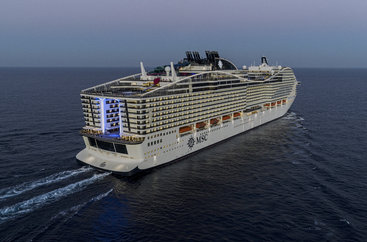
Guadeloupe, Saint Lucia, Barbados from Pointe-à-Pitre na lodi MSC World Europe
| Ship: | MSC World Europe |
|---|---|
| Route: | Guadeloupe, Saint Lucia, Barbados |
| Embarkation: | Pointe-à-Pitre, French Overseas Department |
| Disembarkation: | Bridgetown, Barbados |
| Duration: | 2 nights |
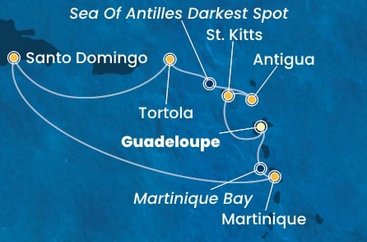
Guadeloupe, Saint Kitts and Nevis, Antigua and Barbuda, Britské Panenské ostrovy, Dominican Republic, Martinik from Pointe-à-Pitre na lodi Costa Favolosa
| Ship: | Costa Favolosa |
|---|---|
| Route: | Guadeloupe, Saint Kitts and Nevis, Antigua and Barbuda, Britské Panenské ostrovy, Dominican Republic, Martinik |
| Embarkation and disembarkation: | Pointe-à-Pitre, French Overseas Department |
| Duration: | 7 nights |
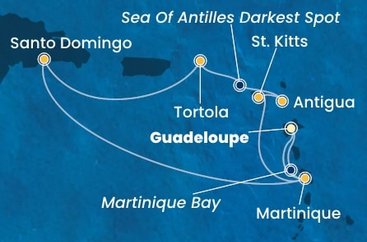
Guadeloupe, Martinik, Saint Kitts and Nevis, Antigua and Barbuda, Britské Panenské ostrovy, Dominican Republic from Pointe-à-Pitre na lodi Costa Favolosa
| Ship: | Costa Favolosa |
|---|---|
| Route: | Guadeloupe, Martinik, Saint Kitts and Nevis, Antigua and Barbuda, Britské Panenské ostrovy, Dominican Republic |
| Embarkation and disembarkation: | Pointe-à-Pitre, French Overseas Department |
| Duration: | 8 nights |
Cruises to Pointe-à-Pitre:
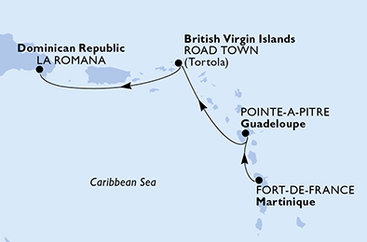
Martinik, Guadeloupe, Britské Panenské ostrovy, Dominican Republic from Fort-de-France na lodi MSC Opera
| Ship: | MSC Opera |
|---|---|
| Route: | Martinik, Guadeloupe, Britské Panenské ostrovy, Dominican Republic |
| Embarkation: | Fort-de-France, French Overseas Department |
| Disembarkation: | La Romana, Dominican Republic |
| Duration: | 3 nights |
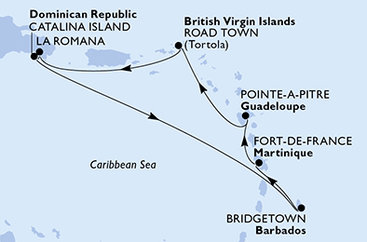
Dominican Republic, Barbados, Martinik, Guadeloupe, Britské Panenské ostrovy from La Romana na lodi MSC Opera
| Ship: | MSC Opera |
|---|---|
| Route: | Dominican Republic, Barbados, Martinik, Guadeloupe, Britské Panenské ostrovy |
| Embarkation and disembarkation: | La Romana, Dominican Republic |
| Duration: | 7 nights |
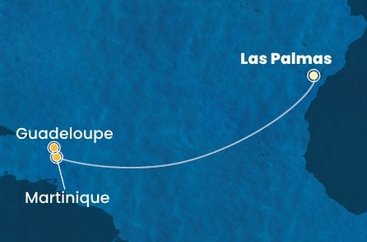
Spain, Martinik, Guadeloupe from Las Palmas na lodi Costa Favolosa
| Ship: | Costa Favolosa |
|---|---|
| Route: | Spain, Martinik, Guadeloupe |
| Embarkation: | Las Palmas, Spain |
| Disembarkation: | Pointe-à-Pitre, French Overseas Department |
| Duration: | 8 nights |