


Cádiz / Spain
Cádiz is located on the southwestern coast of Spain, on a narrow strip of land surrounded by the waters of the Atlantic. Thanks to its extraordinary location, long maritime tradition, and history dating back to the Phoenicians, it is considered one of the oldest continuously inhabited cities in Western Europe. The historic center has retained a labyrinth of narrow streets, small squares, and typical houses with lookout towers, while the coast is lined with promenades and sandy beaches. Cádiz is one of the most interesting Andalusian stops during cruises on the Atlantic Ocean and also a starting point for visiting Jerez de la Frontera, Seville, and other places in southern Andalusia.
What to taste in Cádiz?
The cuisine of Cádiz is primarily based on fresh fish and seafood, complemented by simple Andalusian recipes and famous wines from nearby Jerez.
- Pescaíto frito – a mix of smaller fish coated in flour and quickly fried in olive oil. One of the most typical specialties of Cádiz and all of Andalusia.
- Tortillitas de camarones – thin crispy pancakes made from small shrimp, flour, onion, and parsley, which are among the most characteristic dishes of the Cádiz area.
- Atún rojo de almadraba – bluefin tuna caught using the traditional almadraba method, which has been used on the coast of the Cádiz province for centuries. It is most associated with the area around Barbate and Zahara de los Atunes.
- Cazón en adobo – pieces of shark marinated in vinegar, garlic, oregano, and spices, then fried. They are often served as tapas in local bars.
- Papas aliñás – a simple cold salad of boiled potatoes, onion, parsley, olive oil, and vinegar, typical of Cádiz.
- Sherry – the famous fortified wine comes from the area between the towns of Jerez de la Frontera, Sanlúcar de Barrameda, and El Puerto de Santa María. It pairs excellently with local seafood, especially dry fino or manzanilla.
Why will you love Cádiz?
- Historic city surrounded by the ocean – the narrow streets of old Cádiz lead between small squares, markets, and houses with characteristic lookout towers. The city's panorama is dominated by the cathedral with a golden dome, while from the Torre Tavira tower, one of the best views of the city and the Atlantic opens up.
- Beaches right by the historic center – just a few minutes from the old city quarters lies La Caleta, a small beach nestled between the forts of San Sebastián and Santa Catalina. The longer Playa de la Victoria offers a wide strip of sand and the typical atmosphere of the Andalusian coast.
- Andalusian atmosphere and carnival – Cádiz is known for its relaxed lifestyle, tapas bars, bustling market, and especially the famous Carnaval de Cádiz, which is one of the most significant carnival celebrations in Spain.
Practical tips:
- Official language: Spanish. Cádiz is located in Andalusia, where a characteristic Andalusian dialect is spoken; in tourist areas, you can usually communicate in English as well.
- Currency: Euro (EUR)
- Opening hours: Smaller shops are usually open from about 10:00 to 14:00 and again from late afternoon to 20:00 or 21:00, although more and more shops in the center remain open continuously. Restaurants follow the Spanish rhythm – lunch is commonly served from 13:30 or 14:00 and dinner often not until 20:00 or 21:00. Smaller shops may be closed on Sundays.
- Public transport: The historic center of Cádiz is compact, mostly flat, and best explored on foot. City buses connect the old town with newer districts and beaches, such as Playa de la Victoria. Cádiz also has rail and bus connections with Jerez de la Frontera and other cities in the region. For a longer trip to Seville , you can use a train or organized tour.
- Weather: Cádiz has a mild Mediterranean climate significantly influenced by the Atlantic. Summers are warm, sunny, and relatively dry, but thanks to the ocean, they are not as oppressive as in inland Andalusia. Spring and autumn are very pleasant for sightseeing. Throughout the year, you should expect wind, which is typical for the coast of the Cádiz province.
The most interesting from the history of Cádiz:
The origins of Cádiz date back to around 1100 BC, when, according to ancient tradition, the Phoenicians from Tyre founded the settlement of Gadir, which became an important trading point on routes between the Mediterranean and the Atlantic. Later, the city was controlled by the Carthaginians and subsequently the Romans, who knew it as Gades and built, among other things, a large theater there. After the fall of the Roman Empire, Cádiz lost some of its importance and was successively ruled by the Visigoths and Moors until it was captured in the 13th century by the Castilian king Alfonso X the Wise. A new period of prosperity was brought by overseas discoveries and trade with America; some of Christopher Columbus's expeditions set sail from Cádiz, and in the 18th century, the city became the main Spanish port for trade with the American colonies. Cádiz gained a crucial place in Spanish history during the Napoleonic Wars, when the Spanish legislative assembly, known as the Cádiz Cortes, met here and in 1812 adopted the first modern Spanish constitution, known as La Pepa. After the loss of most Spanish colonies, the importance of overseas trade declined, but the city retained an important role as a maritime port. Today, Cádiz combines an extraordinarily long history with vibrant Andalusian culture and remains one of the most important ports in southern Spain.
Useful information
Port map:
Places worth seeing:

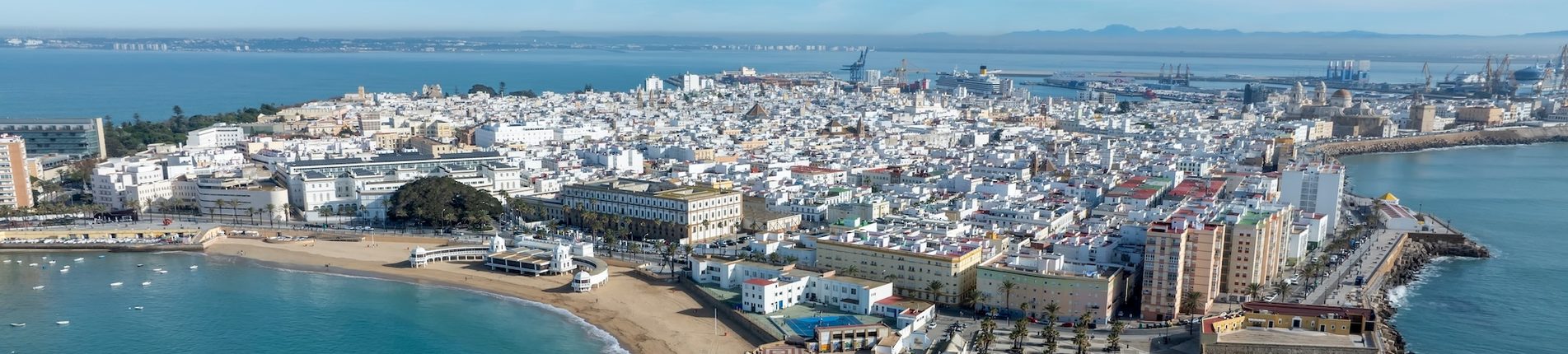
Cádiz patří k nejstarším nepřetržitě osídleným městům západní Evropy a jeho historie sahá více než tři tisíce let do minulosti. Přístavní město na pobřeží Atlantiku si dodnes zachovává typickou andaluskou atmosféru s úzkými uličkami, náměstími a domy s vyhlídkovými věžemi.

Katedrála v Cádizu se svou charakteristickou zlatavou kupolí patří k nejvýraznějším dominantám města. Stavěla se více než sto let, v letech 1722–1838, a proto se v její architektuře prolínají barokní a neoklasicistní prvky.

Pohled na Cádiz krásně ukazuje jeho neobvyklou polohu na úzkém poloostrově, který je téměř ze všech stran obklopen Atlantikem. Nad střechami historického centra vyniká zlatavá kupole katedrály Santa Cruz, jednoho z hlavních symbolů města.


Getting to the port:
Cruise ships dock at the port of Cádiz right next to the historic city center. The main cruise terminal is located at the Alfonso XIII pier, another terminal is at Muelle Ciudad; the specific docking location depends on the ship. The port's location is extremely convenient – it's approximately 5 minutes on foot from the terminal to the center of Cádiz, so there's no need to use a shuttle bus. At Muelle Ciudad, the exit leads directly to Paseo de Canalejas and Plaza de San Juan de Dios. Taxis and tourist buses are available in front of the terminal, city buses stop nearby, and the train station is about a 10–15 minute walk. Cádiz is also a starting point for organized trips to places like Jerez de la Frontera, Seville, or other parts of Andalusia.
Cruises to Cádiz:

Spain, Morocco, Italy from Barcelona na lodi MSC Magnifica
| Ship: | MSC Magnifica |
|---|---|
| Route: | Spain, Morocco, Italy |
| Embarkation: | Barcelona, Spain |
| Disembarkation: | Civitavecchia (Rome), Italy |
| Duration: | 7 nights |

Spain, United Kingdom, Portugal from Barcelona na lodi Norwegian Dawn
| Ship: | Norwegian Dawn |
|---|---|
| Route: | Spain, United Kingdom, Portugal |
| Embarkation: | Barcelona, Spain |
| Disembarkation: | Lisbon, Portugal |
| Duration: | 7 nights |

Spain, Morocco, Italy, France from Barcelona na lodi MSC Magnifica
| Ship: | MSC Magnifica |
|---|---|
| Route: | Spain, Morocco, Italy, France |
| Embarkation and disembarkation: | Barcelona, Spain |
| Duration: | 10 nights |