


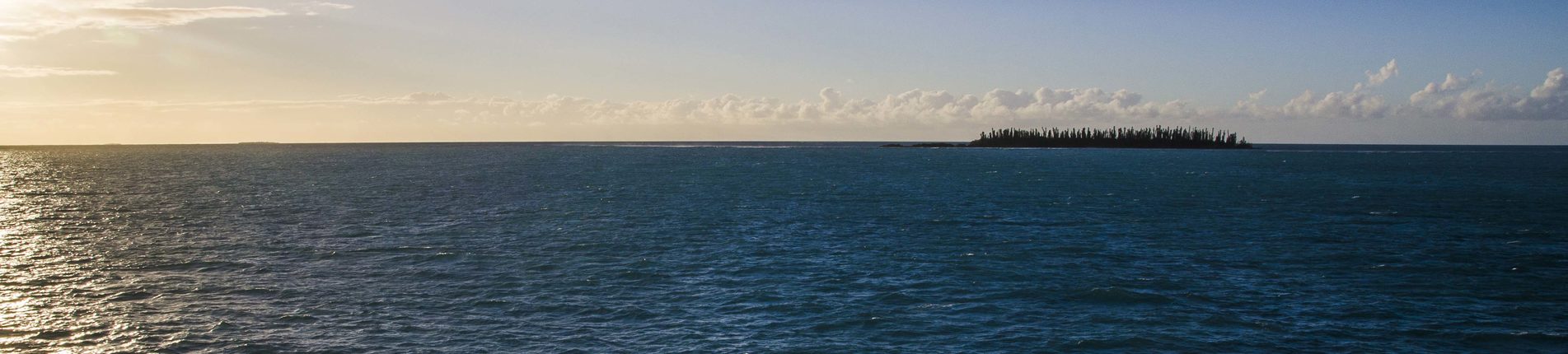
Isle of Pines (New Caledonia) / French Sui Generis Collectivity
In the southern part of the New Caledonia archipelago, southeast of its largest island, Grande Terre, lies the Isle of Pines. This small island in the southern Pacific Ocean has about 2,000 inhabitants, most of whom are Kanaks.
Melanesians inhabited the Isle of Pines more than 2,000 years before Europeans first landed there. In 1774, Captain James Cook saw the island during his second voyage to New Zealand and named it after its pines, the Isle of Pines. In the 1840s, Protestant and Catholic missionaries and traders arrived, eager for the local sandalwood. In 1853, the French took control of the island, and in 1872, the Isle of Pines became a penal colony and home to 3,000 political exiles. Today, along with the rest of New Caledonia, it remains a French overseas territory and a popular destination for cruise ships on their voyages along the coast of Australia and the South Pacific.
One of the most beautiful islands in the southern Pacific measures only 15 kilometers in length and 13 kilometers in width, yet it offers many stunning places worth exploring. It is known primarily for its white sandy beaches, turquoise lagoons, and tall pines, which gave it its name and nicknames "the island closest to Paradise" and "the jewel of the Pacific."
Fairytale beaches await visitors right at the port in Kuto Bay on the island's southern coast, and more in the neighboring Kanumera Bay with the large sacred rock Kaa Nue Mera, ideal not only for families with children but also for snorkeling enthusiasts. They will also be in the right place in Oro Bay with a natural pool lined with tall pines and bordered by a coral reef with countless colorful tropical fish, where not only stingrays but also octopuses or sea turtles are often seen.
On the island surrounded by the Great Caledonian Barrier Reef, a fascinating wealth of plant and animal species also awaits divers. They should not miss the Gadji region at the northern tip of the island, where fossilized crustacean shells or a cave system with an underwater cathedral are hidden beneath the sea surface. Another great diving destination is Grotte de la troisieme, the Third Cave, with a crystal-clear pond and beautiful stalactite decorations beneath its surface. Those who want to stay dry while spelunking can head to the Cave of Queen Hortense, the heir to the throne, who reportedly hid here for a year from enemies.
The island's penal past is now only remembered by the ruins of Vestiges du Bagne north of Kuta, a pyramid-shaped monument, and the graves of three hundred exiles who died here between 1872 and 1880. The village of Vao was founded where Christian missionaries first arrived on the southern coast of the Isle of Pines, and where, in addition to the ruins of several colonial buildings, there is also a pretty church, the only one on the entire island.
In the southern part of the Isle of Pines, Pic Nga rises to the sky, at 262 meters above sea level, the highest peak on the island. The climb takes about an hour, but those who undertake it will be rewarded for their effort with breathtaking views of the green island surrounded by a sea of all shades of blue.
Places worth seeing
Vestiges du Bagne – At the ruins of the penal camp, glimpse into the island's past, where several thousand political exiles lived in the second half of the 19th century.
Grotte de la Reine Hortense – Enjoy the peaceful and mysterious atmosphere of the majestic cave where the Kanak Queen Hortense once hid.
Baie de Gadji – Explore the fascinating life and stunning caves beneath the surface of the tropical sea.
Piscine Naturelle d’Oro – Swim in the beautiful lagoon with turquoise blue water and coral reefs full of life.
Baie de Kanumera – Enjoy snorkeling at the white sandy beach with the sacred rock.
Pic Nga – Be enchanted by the breathtaking views from the island's highest peak, aptly nicknamed the jewel of the Pacific.
Ile Moro – Take a boat trip to the fairytale islet off the shores of the Isle of Pines and swim with stingrays, sharks, or sea turtles.
Places worth seeing:

Korálové ostrovy na Ananasovým ostrově, Nová Kaledonie

Korálové ostrovy na Ananasovým ostrově, Nová Kaledonie


