


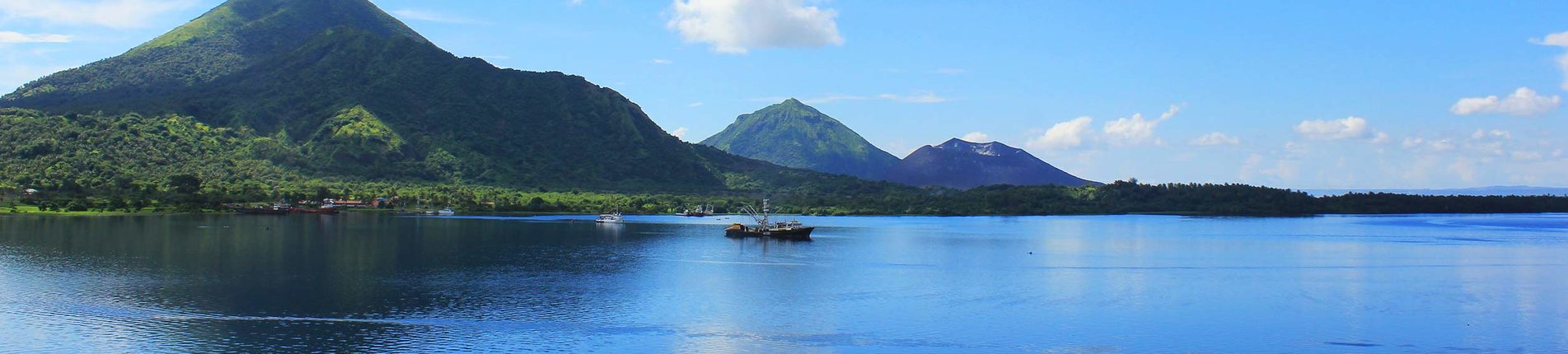
Rabaul / Papua New Guinea
On the northeastern coast of New Britain, the largest of the Bismarck Archipelago of Papua New Guinea, lies Rabaul on the shores of the Bismarck Sea. The port in Blanche Bay in the East New Britain Province has about 8,000 inhabitants.
The town was built around Simpson Harbor during the time when the region was controlled by Germany between 1884 and 1919. From 1910, Rabaul served as the headquarters of German New Guinea until the beginning of World War I, when Britain took over the area. Until 1937, when it was first destroyed by a volcanic eruption, the town was the center of the Australian Territory of New Guinea, and during World War II, it was a base for the Japanese Navy in the South Pacific. Until 1994, Rabaul was the provincial capital, but in 1994 it was again destroyed by volcanic ash fallout, and the capital was moved to nearby Kokopo. Today, Rabaul is sought after for its volcanoes, excellent diving and snorkeling, stunning scenery, war history, and unique fauna and flora.
The period of German colonization is brought closer by a small but interesting museum housed in the building of the former New Guinea Club. The beautiful colonial building survived World War II and the subsequent volcanic eruption and is worth a visit, as are its historical photographs and artifacts.
A frequent destination for visitors is the "old" Rabaul, the remnants of the town destroyed in 1994 by a volcanic eruption. On the way to the foot of the volcano, you can view the ruins of the airport and many houses, but the hot springs that emerge from the ground and mix with the ocean water on the beach are also interesting. Those who are actively inclined should not miss the challenging climb to the summit of Mount Tuvurvur: the effort is rewarded with breathtaking panoramic views of the beautiful scenery of the tropical island. These views are also available from the volcanological observatory, established after the eruption of the 1930s, which aims to monitor the activity of 14 active and 23 dormant volcanoes in the archipelago.
Those interested in war history can visit Admiral Yamamoto's Japanese bunker and the Bita Paka War Cemetery, located about an hour's drive southeast of Rabaul. In the same direction is Kokopo and its war museum, which should be visited by anyone who wants to delve deeper into history. The museum's extensive collection includes Japanese, Australian, and American war artifacts, including small tanks and aircraft wrecks.
Rabaul is a sought-after base for divers and snorkeling enthusiasts, who find a literal treasure under the sea: in addition to colorful fish and other creatures, they encounter shipwrecks sunk in the harbor during World War II.
Those who want to take a nice souvenir from Papua New Guinea can choose a woven basket or a colorful bag made from natural materials at the local market.
Places Worth Seeing
New Guinea Club and Rabaul Museum – Recall the period of German rule over the island in an interesting museum in the former colonial club.
Bita Paka War Cemetery – Visit the beautiful park and the final resting place of World War II victims.
Vulcanological Observatory – Enjoy breathtaking views of the volcanoes and the beautiful scenery of Rabaul Harbor from the volcanological observatory.
Mount Tuvurvur – Admire the old Rabaul buried in volcanic ash, the hot springs emerging on the local beach, and if you have the courage, head to the summit of the active volcano.
Admiral Yamamoto's Bunker – Don't miss a tour of the Japanese bunker and other World War II artifacts.
Kokopo War Museum – Delve into the war history of the former Japanese Navy base in the South Pacific.
Places worth seeing:

Místní děti zkoumající oblast poblíž sopky Tavurvur, Rabaul, Papua Nová Guinea

Erupce sopky Tavurvur u Rabalie, Papua Nová Guinea
Cruises to Rabaul:
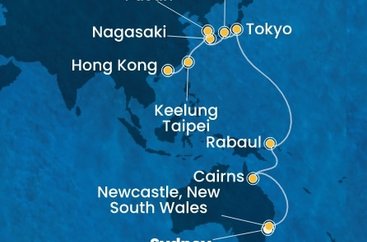
Australia, Papua New Guinea, Japan, South Korea, Taiwan, China from Sydney na lodi Costa Deliziosa
| Ship: | Costa Deliziosa |
|---|---|
| Route: | Australia, Papua New Guinea, Japan, South Korea, Taiwan, China |
| Embarkation: | Sydney, Australia |
| Disembarkation: | Hong Kong, China |
| Duration: | 25 nights |