

Londonderry (Northern Ireland) / United Kingdom
In the northwestern part of Northern Ireland, near the mouth of the River Foyle, lies Londonderry. The city, also known simply as Derry, has about 250,000 inhabitants, making it the second largest in Northern Ireland.
People have lived in the area of today's Derry since ancient times, with the first historical mention of the city dating back to the 6th century when a monastery was founded here, making it one of the oldest continuously inhabited cities in all of Ireland. Between 1613-19, Londonderry was surrounded by walls to protect settlers coming to the area from England and Scotland. They proved effective, and the city withstood the famous 105-day siege of 1689. In the 18th century, Derry was rebuilt in the Georgian style, and in 1790 the River Foyle was bridged for the first time. During the 18th and 19th centuries, the port also gained importance as Irish emigrants set out on their journey to North America. During World War II, Londonderry played an important role in the Battle of the Atlantic, and the American army had a base here. Today, the city is a popular stop for cruise ships, attracting visitors with its interesting architecture and beautiful nature beyond its gates.
The hilly nature of Londonderry accounts for the steep alleys and stunning views that open up from them. On the western bank of the River Foyle lies the old town. Derry is the only city in all of Ireland surrounded by intact walls and one of the most beautiful in all of Europe. The walls, about 1.6 kilometers in circumference, with four original and three new gates, form a lovely promenade with bastions and cannons, from which you can admire views of the historic center of Londonderry. Worth seeing are St. Augustine's Church, Austin's department store with a copper dome, considered the oldest of its kind in the world, or the historic courthouse building.
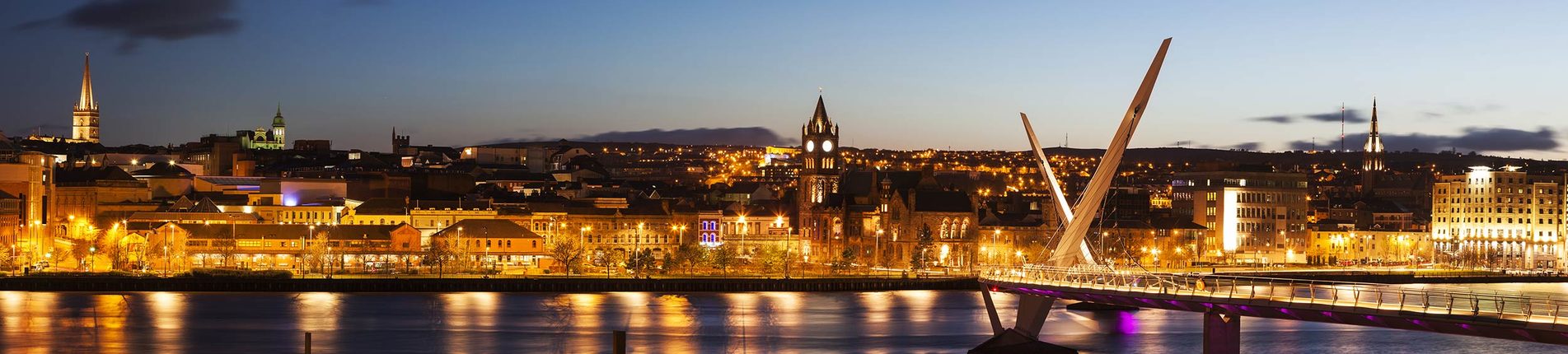
The Gothic St. Columb's Cathedral dates from 1633, and its 67-meter-high tower dominates all of Derry. Conversely, the Peace Bridge, symbolizing the unity of the city's inhabitants on both banks of the river, was only opened in 2011. It begins at the neo-Gothic Guildhall of red brick and is beautifully lit at night.
Londonderry boasts a number of interesting museums and landmarks, including the Foyle Valley Railway Centre, Derry's Craft Village, O'Doherty's Tower and its historic Tower Museum, or the Harbour Museum.
The flat landscape at the river's mouth is protected from the sea by kilometers of embankments and is a popular bird nesting site and one of the most important wetland areas in all of Great Britain. Nature lovers should not miss a visit to Ness Country Park east of Derry or the Prehen Woods on its southern outskirts.
Londonderry is the gateway to the so-called Giant's Causeway, located 70 kilometers to the northeast. About 40,000 interlocking basalt columns, the tallest of which reach up to 12 meters, are the result of volcanic activity and are now listed as a UNESCO World Heritage Site.
Places Worth Seeing
City Walls – Walk along the walls of one of Europe's most beautiful fortified cities and enjoy the lovely views from here.
Tower Museum – Explore the interesting and often turbulent history of the city on the very border of Great Britain and Ireland.
Peace Bridge – Walk across the modern and beautifully lit bridge from 2011, symbolizing the unity of the inhabitants on both its banks.
St Columb's Cathedral – Admire the beautiful cathedral from 1633 and its 67-meter-high tower, dominating the entire city.
Craft Village – Don't miss a visit to the reconstruction of an 18th-century alley lined with charming shops, cafes, and restaurants.
Ness Country Park – Stretch your legs with a walk along kilometers of footpaths through the beautiful wetland landscape beyond the city's gates.
Giant's Causeway – Be enchanted by the fascinating scenery of tens of thousands of basalt columns, listed as a UNESCO World Heritage Site.
Places worth seeing:

Guildhall - budova, kde se scházejí členové rady Derry a Strabane, Londonderry, Severní Irsko

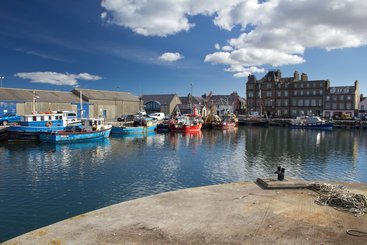
Pobřeží v Londonderry, Severní Irsko