

Greenock / United Kingdom
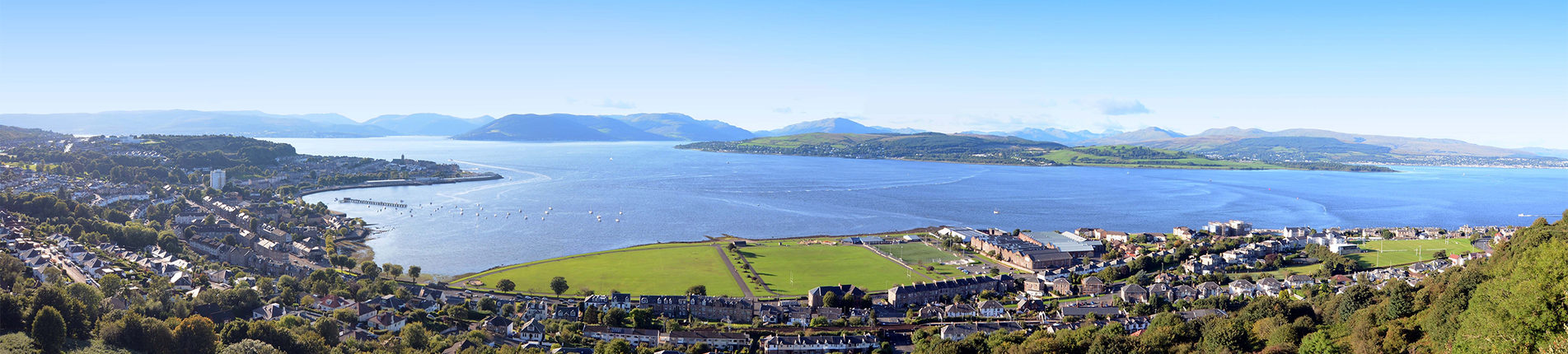
On the western coast of Scotland (Great Britain), where the river Clyde widens into the sea inlet Firth of Clyde, lies Greenock, a port city with a rich maritime history and impressive views of the surrounding hills. Its appearance is still shaped by elegant Victorian buildings, old port districts, and reminders of the times when local shipyards were significant centers of British shipbuilding. Above the city rises Lyle Hill, offering a magnificent panorama of the bay, while the surrounding green valleys, lakes, and typical Scottish landscape beckon. Greenock is also an excellent starting point for visiting Glasgow, Scotland's largest city, and the picturesque area of Loch Lomond. During cruises in Northern Europe, it offers an interesting combination of maritime traditions, urban architecture, and the natural beauty of western Scotland.
What to taste in Greenock?
The cuisine of western Scotland is based on traditional recipes, quality beef and lamb, fresh fish, and seafood. Local restaurants and pubs offer hearty meals that are perfect for the changeable Scottish weather.
- Haggis – a traditional Scottish dish made from sheep's offal, oatmeal, onions, and spices, usually served with mashed potatoes and turnips (neeps and tatties).
- Cullen skink – a thick creamy soup made from smoked haddock, potatoes, and onions, originating from northeastern Scotland but popular throughout the country.
- Scotch pie – a small round meat pie with a flaky crust, traditionally filled with spiced mutton or beef.
- Fish and chips – fried fish in a crispy batter with chips, a popular classic of port cities.
- Cranachan – a traditional Scottish dessert made from whipped cream, raspberries, toasted oatmeal, honey, and whisky.
- Scottish whisky – the famous national drink, whose diverse types reflect the long tradition of Scottish distilling.
Why will you love Greenock?
- Impressive views of the Clyde River – From the Lyle Hill viewpoint, a panorama of the wide bay, port, and green hills on the opposite shore opens up. On a clear day, you can also admire the distant mountain peaks of western Scotland.
- Maritime history and Victorian architecture – Greenock recalls the glorious era of Scottish shipbuilding and overseas trade. Notable sites include the Custom House, the monumental Victoria Tower, and the collections of the McLean Museum and Art Gallery, which illustrate the history of the city and its inhabitants.
- Gateway to the beauties of western Scotland – Thanks to its convenient location, you can visit the culturally rich Glasgow, head to the romantic lake Loch Lomond, or explore picturesque towns and landscapes along the Clyde bay in a single day.
Practical tips:
- Language: English is used officially and in everyday life, often with a distinct Scottish accent. Scots and Scottish Gaelic also have their place in Scotland.
- Currency: The British pound (GBP) is used. In Scotland, you may encounter Scottish banknotes, which have the same value as those issued by the Bank of England. Credit cards are widely accepted.
- Opening hours: Shops are generally open from 9 am to 5 or 6 pm, with larger shopping centers open longer. On Sundays, opening hours may be shorter. Museums and tourist attractions have their own operating hours, which should be checked before visiting.
- Public transport: Greenock has bus and rail connections. Direct trains run to Glasgow from Greenock Central and Greenock West stations, taking approximately 35–45 minutes depending on the service. Greenock's center can be easily explored on foot, with buses and taxis available for more distant destinations. In the UK, driving is on the left.
- Weather: Western Scotland has a mild oceanic climate with frequent rainfall and rapid weather changes. In summer, daytime temperatures usually range from 16–20 °C, and in winter, approximately between 3–8 °C. Even on a sunny day, it's worth having a waterproof jacket and windproof clothing.
The most interesting from Greenock's history:
Greenock began to develop significantly in the 16th and 17th centuries as a fishing settlement and port on the Clyde River. A significant milestone was the early 18th century when new port docks were built here, and the town became involved in the developing overseas trade, including trade links associated with colonial economy and slavery. During the industrial revolution, Greenock transformed into an important center for shipbuilding, engineering, and maritime transport. In 1736, James Watt was born here, whose improvements to the steam engine significantly influenced the industrial development of the entire world. In the 19th century, the town experienced a period of prosperity, still reflected in its representative public buildings and Victorian architecture. During World War II, Greenock was an important naval port and suffered extensive damage in May 1941 during the German bombing known as the Greenock Blitz. Although traditional shipyards gradually lost their significance in the second half of the 20th century, Greenock has retained its character as a significant port city and today also serves as a gateway for cruise ships heading to western Scotland.
Useful information
Port map:
Places worth seeing:

Clyde Arc, přezdívaný Squinty Bridge (Šikmý most), je moderní obloukový most přes řeku Clyde v Glasgow, otevřený v roce 2006. Svou charakteristickou podobou a neobvyklým šikmým vedením přes řeku se stal jedním ze symbolů moderní architektury města.

Glasgowská katedrála, zasvěcená svatému Mungovi, je jednou z nejvýznamnějších středověkých památek Skotska a vzácným příkladem gotické architektury. Její počátky sahají do 12. století a v působivé kryptě se nachází hrob svatého Munga, patrona města Glasgow.

Památník Svobodné Francie (Free French Memorial) na vrchu Lyle Hill v Greenocku připomíná francouzské námořníky, kteří během druhé světové války bojovali po boku Spojenců. Monument ve tvaru lotrinského kříže nabízí také nádherný výhled na záliv Firth of Clyde.


Getting to the port:
Cruise ships arrive at Greenock Ocean Terminal, which is located on the south bank of the River Clyde, near the center of Greenock and approximately 40 km west of Glasgow. The modern terminal at Custom House Way, Greenock, PA15 1EG allows direct disembarkation of passengers and offers a tourist information center, refreshments and other services. The historic center of Greenock can be easily reached on foot, while for a visit to Glasgow, train connections are available from the nearby station Greenock Central, from where the journey takes approximately 35–40 minutes. Also available are taxis and organized cruise company tours to Glasgow, Loch Lomond and other attractions of western Scotland.
Cruises to Greenock:
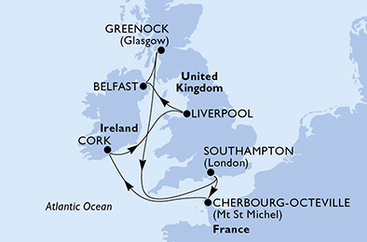
United Kingdom, France, Ireland from Southampton aboard MSC Meraviglia
| Ship: | MSC Meraviglia |
|---|---|
| Route: | United Kingdom, France, Ireland |
| Embarkation and disembarkation: | Southampton, United Kingdom |
| Duration: | 7 nights |
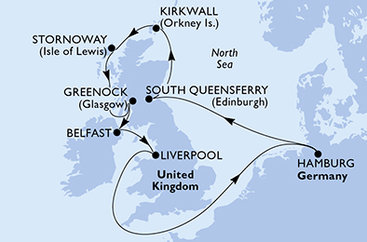
Germany, United Kingdom from Hamburg aboard MSC Preziosa
| Ship: | MSC Preziosa |
|---|---|
| Route: | Germany, United Kingdom |
| Embarkation and disembarkation: | Hamburg, Germany |
| Duration: | 10 nights |