


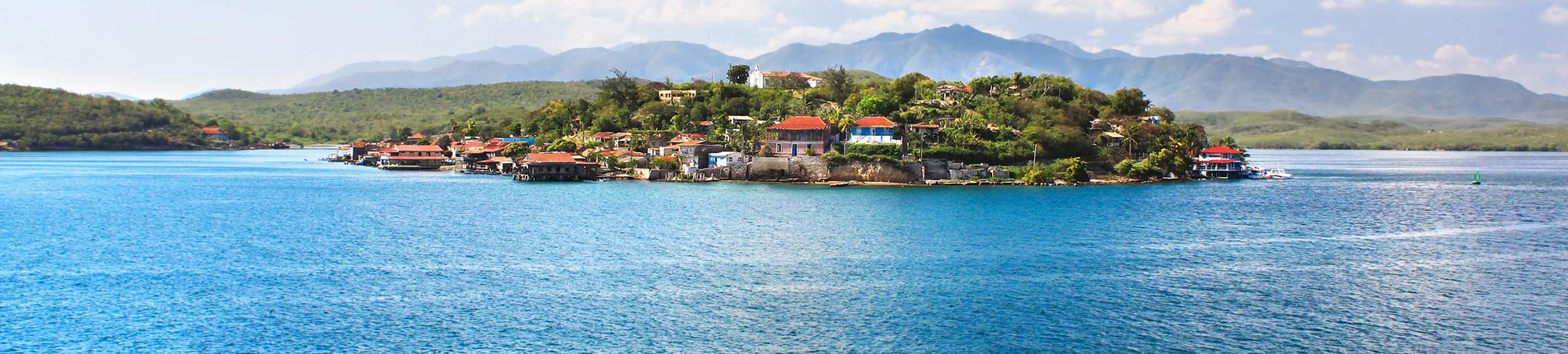
Santiago De Cuba / Cuba
On the southeastern coast of Cuba, on the shore of the bay of the same name in the Caribbean Sea, lies the country's second-largest city, Santiago de Cuba. The capital of the Santiago de Cuba province has about 430,000 inhabitants.
Santiago was founded by the Spanish in 1515 and between 1522 and 1589 was the capital of all Spanish Cuba. In the second half of the 16th and early 17th centuries, the city was attacked several times by the British and French, and at the end of the 18th and early 19th centuries, it became a frequent destination for immigrants from these countries. In the Spanish-American War in 1898, Santiago was defeated, Cuba declared independence, but for several subsequent years was occupied by the United States. In the 1950s, Santiago became a significant center of the Cuban revolution, today it is a cultural center of the country, an important seaport, and a popular tourist destination.
Santiago is known for its well-preserved architecture across historical styles from Baroque to Neoclassicism. From the large windows and wide balconies of colonial houses, there are beautiful views of the city's steep streets and the wooded mountains beyond its gates. Among the most valuable monuments are the first Spanish house on American soil or the Cobre copper mine, the oldest on the American continent.
In the very southwestern tip of the city, on the shore of the Santiago de Cuba bay, rises the majestic citadel of San Pedro de la Roca. Built in the 17th century, today it is inscribed on the UNESCO list as a well-preserved example of Spanish-American military architecture. Visitors can view the pirate museum here or admire the beautiful views of the sea.
Already in the 1520s, a colonial church was built in Santiago, on the site of which stands the magnificent Cathedral of the Annunciation of the Virgin Mary with two neoclassical towers, completed in 1922. In the former military barracks of Moncada in the Art Deco style, Castro's revolution began in 1953, today there are a number of authentic artifacts and interesting photographs for those interested in revolutionary history.
World-famous Bacardi rum was born in Santiago, a brand founded by Facundo Bacardi as early as 1862. The rum magnates were also great patrons of the arts and gathered an extensive collection of Cuban art and works brought from abroad in the family museum, a wide collection of weapons, or the only Egyptian mummy on the island.
Those who prefer nature to monuments can visit Jardín de los Helechos, a beautiful garden with 350 species of ferns and nearly a hundred species of orchids.
About an hour and a half drive east of Santiago lies Baconao, a UNESCO-listed biosphere reserve with a number of attractions. From the Great Rock at an altitude of 1,234 meters, it is said that even the lights of Jamaica can be seen on dark nights, and the Prehistoric Valley is dominated by dozens of life-size dinosaur models. There is also an aquarium with an underwater tunnel and a dolphinarium or a reproduction of a village of the original Caribbean Taíno people.
The streets of Santiago are an ideal place to taste Cuban specialties, such as empanadas, pastries filled with meat or vegetables, arroz con pollo, rice with chicken, or cocido de gabanzos, chickpeas stewed with meat and vegetables. Anyone who hasn't drunk Bacardi in Santiago hasn't really been there.
Places worth seeing
Museo de Moncada – Get acquainted with the context of Castro's revolution in the beautiful Art Deco building of the former military barracks.
Castillo de San Pedro de la Roca – Admire the UNESCO-listed 17th-century citadel and the beautiful views of the sea that open from here.
Catedral de Nuestra Senora de la Asuncion – Be enchanted by the beautiful cathedral, built on the site of a colonial church from 1528.
Jardín de los Helechos – Stroll through the beautiful botanical garden with hundreds of species of ferns and orchids from around the world.
Cementerio de Santa Ifigenia – Don't miss the changing of the guard at the historic cemetery, where poet José Marti, rum magnate Emilio Bacardi, and other Cuban personalities have their tombstones.
Parque de Baconao – Visit the UNESCO biosphere reserve with stunning views, life-size dinosaurs, a museum, and an aquarium.
Cayo Granma – Enjoy the peaceful atmosphere of a traditional fishing village on an islet at the mouth of the Santiago de Cuba bay into the Caribbean Sea.
Places worth seeing:

Slavná bazilika El Cobre, která se nachází 20 km od Santiaga de Cuba, Kuba

Pláže v Santiago de Cuba, Kuba
