


Vigo / Spain
Vigo, with just under 300,000 inhabitants, is the largest city in Galicia. It is located in one of the Rias Baixas bays on the Atlantic coast and is one of the major Spanish ports. The city is only 20 km from the Portuguese border and about 80 km from Spain's most important religious center, Santiago de Compostela.
The bay was inhabited as early as prehistoric times, but Vigo itself was an insignificant fishing settlement until the 15th century. Constant attacks from the sea hindered the development of trade. Moreover, the plundering by Vikings, Saracens, and the English did not help the situation. It wasn't until Spanish King Philip IV decided in 1656 to fortify the settlement and build a massive fortress here. Thanks to this, Vigo could finally begin to develop as a port and trading station. In 1702, one of the important battles of the War of the Spanish Succession took place here. In the Bay of Vigo, the English and Dutch fleets clashed against the combined fleets of Spain and France. The battle ended in a huge success for the British and Dutch, who destroyed or captured almost all of the opponent's ships. Seventeen years later, the Spanish fleet set sail from here again to support the Scottish Jacobites. The city grew rapidly in the 19th and 20th centuries, becoming an important industrial and cargo port. Today, Vigo is considered the economic and industrial center of Galicia. It is also the largest fishing port in Europe, home to Pescanova, the world's largest fishing company.
Visitors to Vigo can enjoy a beautiful historic center with the 17th-century Castro fortress or the collegiate church of Santa Maria de Vigo. A walk through the narrow streets with numerous shops and restaurants is also very pleasant. Among other things, there are several interesting museums and beautiful sandy beaches.
A large part of tourists, however, head to visit Santiago de Compostela, one of the main pilgrimage sites in Europe. The remains of the apostle St. James the Greater, discovered here in the 9th century, are kept in the local cathedral. Since then, the place has become the destination of the Camino de Santiago pilgrimage, which has been revived in recent years. In the city, listed as a UNESCO World Heritage Site, we find the enormous Cathedral of St. James, many Christian monasteries, hospices, and other religious buildings. The historic center is exceptionally well-preserved and certainly ranks among the most impressive places in Spain.
Places worth seeing:
- Vigo – Casco vello (old town)
- Ria de Vigo
- Santiago de Compostela – cathedral
- Santiago de Compostela – old town
- Pontevedra
Enjoy local specialties…
Sardinas lañadas a lo picadillo – stuffed sardines
Bacalao al horno con pasas – baked cod with raisins
Sopa de castañas – chestnut soup
Wines – Albariño, Ribeiro, etc.
Cheeses – Tetilla, Arzúa, San Simón da Costa, etc.
Tarta de Santiago – almond cake
Places worth seeing:

Pohled na přístav s kotvícími plachetnicemi ve městě Vigo, Španělsko

Typické stavby starého Viga, Španělsko
Cruises to Vigo:

Portugal, Spain, France, United Kingdom, Denmark, Germany from Leixoes (Porto) na lodi Costa Diadema
| Ship: | Costa Diadema |
|---|---|
| Route: | Portugal, Spain, France, United Kingdom, Denmark, Germany |
| Embarkation: | Leixoes (Porto), Portugal |
| Disembarkation: | Kiel, Germany |
| Duration: | 8 nights |
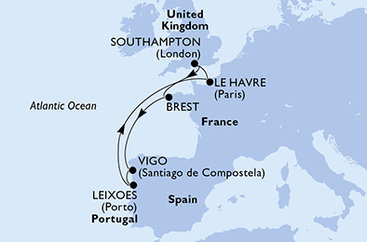
United Kingdom, France, Spain, Portugal from Southampton na lodi MSC Meraviglia
| Ship: | MSC Meraviglia |
|---|---|
| Route: | United Kingdom, France, Spain, Portugal |
| Embarkation and disembarkation: | Southampton, United Kingdom |
| Duration: | 7 nights |

USA, Portugal, Spain, France, United Kingdom from Miami na lodi Norwegian Jewel
| Ship: | Norwegian Jewel |
|---|---|
| Route: | USA, Portugal, Spain, France, United Kingdom |
| Embarkation: | Miami, USA |
| Disembarkation: | Southampton, United Kingdom |
| Duration: | 15 nights |