


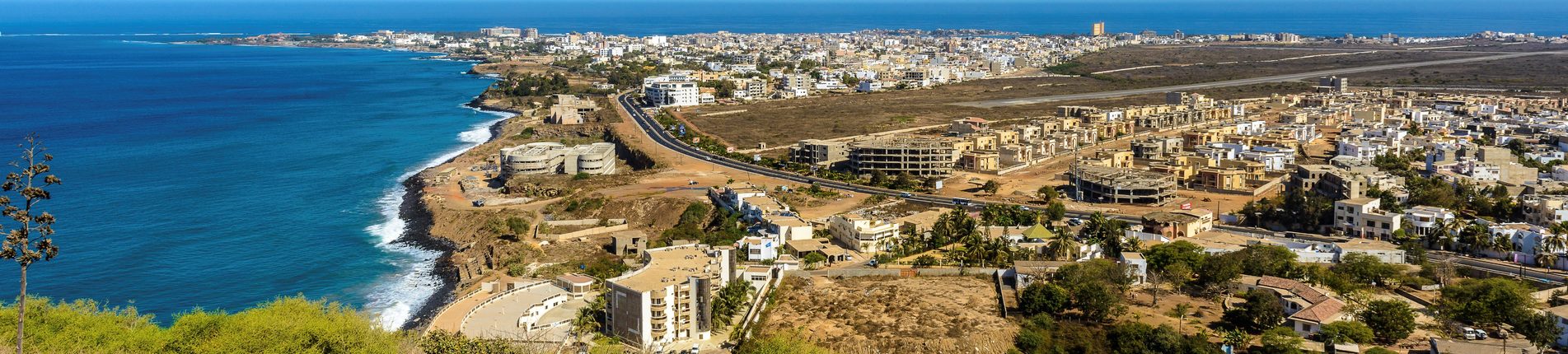
Dakar / Senegal
On the western coast of Senegal, on the shores of the Atlantic Ocean, lies Dakar. The port on the Cap-Vert peninsula is the westernmost city on the African mainland and the country's capital and largest city, with over a million inhabitants.
The area around present-day Dakar was settled in the 15th century by the ethnic group of Lebou people, and in the first half of the 16th century, the Portuguese established their slave trade base on the nearby island of Gorée. In 1677, France took control of the island, and after slavery was banned and the French also took over the mainland part of the country, Dakar became an important port and center of French colonial rule in Africa, and in 1902, it even became the capital of French West Africa. Between 1959-60, the city was the center of the short-lived Mali Federation, and shortly thereafter, it was chosen as the capital of independent Senegal. Dakar gained international recognition between 1978-2007 as the final destination of the famous rally.
The center of Dakar is the bustling Independence Square, lively both day and night. The Presidential Palace was built in 1907 and is now the seat of the government, while the Dakar Cathedral, dating from 1936, features beautiful stained glass windows and a magnificently painted dome.
The traditional district of Médina was built during the French colonial era as a city for the indigenous population, and today, some of its biggest attractions are the Soumbédioune street market and the Great Mosque from 1964 with its beautiful minaret.
Art and culture enthusiasts should not miss a visit to the Théodore Monod Museum, showcasing cultural artifacts including clothing, wood carvings, and musical instruments.
The two hills, Deux Mamelles, are the only elevated points of the city, visible from all its parts. At the top of the first stands the Mamelles Lighthouse, built in 1864, while on the second, the African Renaissance Monument, a 49-meter bronze sculpture celebrating the 50th anniversary of Senegal's independence, considered the tallest statue in all of Africa, rises to the sky: both offer stunning views of the surrounding area.
Off the coast of Dakar lie two islands: besides Gorée, there is also N'Gor with beautiful beaches, popular mainly with surfing enthusiasts. Gorée is still home to unique colonial architecture, for which it was listed as a UNESCO World Heritage site. Among the places worth visiting here are the Gorée Memorial or the Maison des Esclaves (House of Slaves) museum, focused on the Atlantic slave trade.
In Dakar, nightlife lovers will also find their place, inspired by the local mbalax music, a Senegalese genre based on playing an instrument known as the sabar. As for gastronomy, it would be a mistake not to taste thiéboudienne, considered the national dish of Senegal. Well-marinated fish, cooked with tomato paste and vegetables and mixed with rice, is undoubtedly a local delicacy.
Places worth seeing
Médina – Stroll through the traditional district of Dakar, admire the Great Mosque with its beautiful minaret, and shop with the locals at the Soumbédioune market.
Place de l'Indépendance – Be at the center of the action and soak up the authentic atmosphere of a West African metropolis at Dakar's main square.
Musée Théodore Monod – Delve into African art and culture at the excellent museum with a collection of traditional masks, clothing, and musical instruments from across the region.
Le Monument de la Renaissance Africaine – Be enchanted by breathtaking views from the majestic, 49-meter-high monument to Senegal's independence.
Ile de Gorée – Recall the tragic era of slavery on the island, listed as a UNESCO World Heritage site.
Ile de N'Gor – Relax, sunbathe, or catch the right wave on the beautiful beaches of the island off the coast of Dakar.
Cathédrale Notre Dame des Victoires – Admire the beautiful cathedral with lovely stained glass windows and a magnificently painted dome.
Places worth seeing:

Pohled na pobřeží kolem města Dakar, Senegal

Mešita Omarienne v Dakaru, Senegal
