


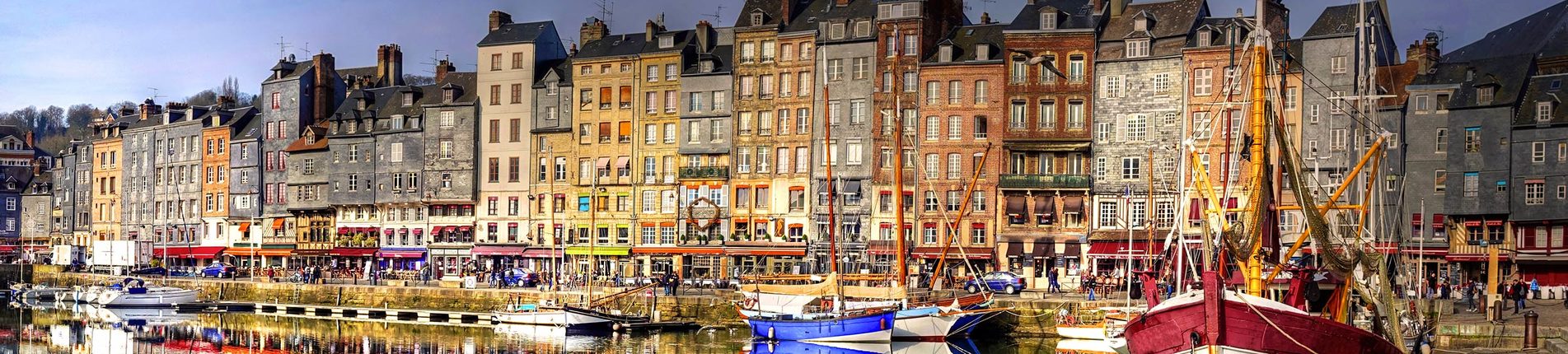
Honfleur / France
On the northwestern coast of France, where the Seine River flows into the English Channel, lies Honfleur. The Norman town has about 9,000 inhabitants.
Already in the mid-12th century, Honfleur was an important transit port and benefited from the flourishing maritime market from the end of the Hundred Years' War until the end of the 18th century. During the French Revolution and the First Empire, the town declined, but partially recovered in the 19th century, thanks to trade in timber from Northern Europe. Today, the birthplace of Impressionism and the port from which French explorers set sail for distant America is one of the most popular destinations in northern France.
The old port, Vieux Bassin, is lined with beautiful townhouses from the 16th to 18th centuries and has rightfully become the subject of many Impressionist painters, including Claude Monet and Eugene Boudin. The town was spared bombing during World War II, so its medieval part has been preserved in almost its original form: cobbled streets lined with narrow half-timbered houses are now home to art galleries, boutiques, restaurants, and souvenir shops.
Already in the second half of the 15th century, shipbuilders erected the wooden structure of the Church of Saint Catherine, the largest wooden church in all of France. Its separate bell tower, beautiful organ, Renaissance balcony, and 19th-century stained glass windows are interesting. A short tour is also definitely worth the stone Church of Saint Stephen from the 14th to 15th century, the oldest in the town.
Of the original three, only two salt warehouses have survived to this day: they were built in the 17th century, largely from the remains of a fortress that protected the port in the 16th century, and at the time housed 10,000 tons of salt, used to preserve the catch of this important fishing port.
Those who want to delve into the history of Honfleur can visit the Maritime Museum with a range of ship models, paintings, or weapons. The Ethnographic Museum, housed in 16th and 17th-century houses, exhibits historical clothing, furniture, folk art, and household items that tell the story of the town's early inhabitants. A must for art lovers is a visit to the Eugene Boudin Museum with exhibitions of works by famous Impressionist painters.
Honfleur is the gateway to significant monuments and sites that commemorate important historical events. Visitors often set out from here to the beaches where Allied forces landed in Normandy on June 6, 1944, or to the American Cemetery, the final resting place of fallen soldiers. A popular stop is also Bayeux, located in the same direction, and its museum of medieval tapestries, containing, among other things, a 69-meter-long piece telling the story of William the Conqueror's invasion of England.
Gourmets in Honfleur should not miss tasting oysters, known here as huitres, or the delicate cheeses – such as camembert, livarot, or neufchatel – for which Normandy is famous.
Places worth seeing
Église catholique Sainte-Catherine – See the largest wooden church in France, built as early as the 15th century.
Musee de la Marine – Delve into the town's history connected with the sea through interesting exhibitions with ship models, historical paintings, and a range of maritime objects.
Old Town – Get lost in the cobbled streets of the medieval town, lined with narrow half-timbered houses with art galleries, restaurants, and boutiques.
Musee Eugene Boudin – Admire the works of famous Impressionist painters, inspired by the port to create a number of stunning works.
Pont de Normandie – Walk across the majestic, 2,143-meter-long bridge over the Seine, connecting Honfleur with the opposite Le Havre.
Musee de la Tapisserie de Bayeux – Be enchanted by the stunning, 69-meter-long tapestry depicting William the Conqueror's invasion of England.
Omaha Beach – Reflect on the events of World War II when Allied forces landed on the beaches of northern France.
Places worth seeing:

Město Honfleur se starým přístavem, Francie

Starý přístav, Vieux Bassin, je lemovaný pěknými městskými domy z 16. – 18. století a ne nadarmo se stal předlohou řady impresionistických malířů včetně Clauda Moneta nebo Eugena Boudina. Honfleur, Francie

