


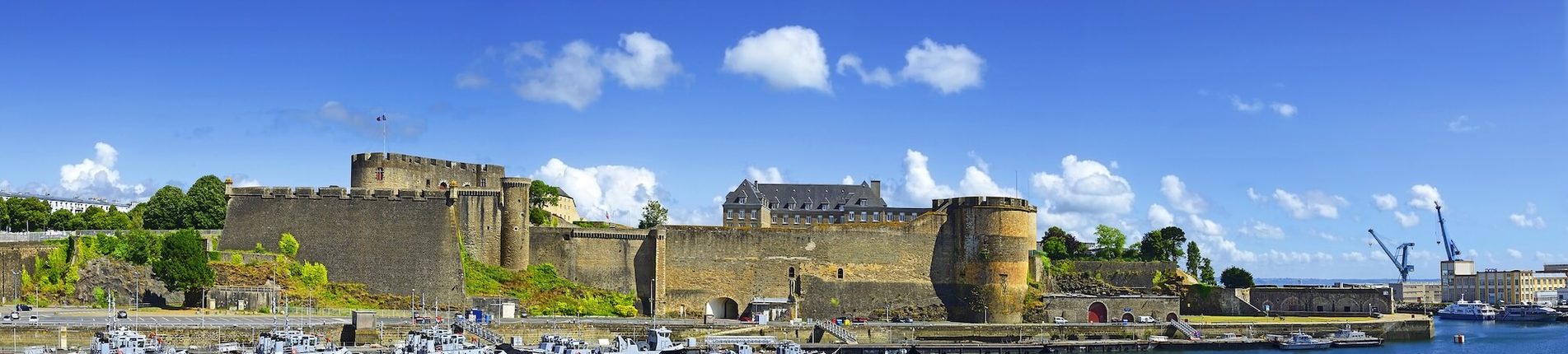
Brest / France
Brest is located on the western edge of Brittany, on the coast of France, in a deep and well-protected bay Rade de Brest. Its location by the Atlantic has destined the city to become one of the most important French naval ports and a crucial base for the French navy. Brest was almost destroyed during World War II, and therefore today it combines modern post-war architecture with several exceptionally valuable reminders of its long history. The city is also a starting point for exploring the dramatic coast of Brittany and an interesting stop during cruises in Northern Europe.
What to taste in Brest?
The cuisine of Brest is based on Breton traditions and naturally features fish, seafood, buckwheat, butter, and apples.
- Crêpes bretonnes – thin Breton pancakes prepared mainly in a sweet variant, often with butter, caramel, sugar, or fruit.
- Galettes de sarrasin – savory buckwheat pancakes filled with ham, cheese, egg, vegetables, or seafood.
- Plateau de fruits de mer – a rich platter of fresh seafood, which may include oysters, shrimp, crabs, langoustines, mussels, and sea snails.
- Kig ha farz – a traditional Breton dish typical especially for the Finistère area, prepared from meat, vegetables, and buckwheat mixture cooked together in one pot.
- Kouign-amann – an exceptionally buttery Breton pastry made from layered dough, sugar, and salted butter, with a caramelized surface when baked.
- Cidre breton – Breton apple cider, traditionally served especially with galettes and crêpes.
Why will you love Brest?
- A city with a maritime history – Brest has been associated with the French navy for centuries, and its most prominent historical monument is the massive Château de Brest, whose origins date back to antiquity. Today, it houses the Musée national de la Marine, which presents the history of the French navy, ships, and life at sea. The castle stands at the mouth of the Penfeld river, opposite the medieval tower Tour Tanguy, another significant reminder of old Brest.
- The ocean at your fingertips – Brest is a city characterized by the Atlantic. One of its most famous attractions is Océanopolis, a large center dedicated to oceans and marine ecosystems. An interesting experience is also a ride on the city cable car over the Penfeld river, which connects the center with the Capucins district and offers unusual views of the port area.
- Gateway to the wild coast of Brittany – the surroundings of Brest belong to the most impressive parts of western France. The peninsulas Crozonand Pointe Saint-Mathieu, rocky capes, lighthouses, and small coastal villages show Brittany in its most typical form. Trips outside the city allow you to combine a visit to a significant naval port with a landscape shaped by wind and the Atlantic.
Practical tips:
- Official language: French, Breton can also be encountered in Brittany.
- Currency: Euro (EUR)
- Opening hours: Shops are usually open from about 9:00 to 19:00, larger shopping centers longer. Many shops are closed on Sundays, but restaurants and tourist sites operate according to their own opening hours.
- Public transport: Brest has a well-functioning network of buses and trams, complemented by the cable car over the Penfeld river. The center can be comfortably walked, for more distant places, such as Océanopolis, city transport is suitable.
- Weather: Brest has a distinct oceanic climate with mild temperatures, frequent wind, and rapidly changing weather. Rain can occur at any time of the year, so it's worth having a waterproof layer even in summer.
The most interesting from the history of Brest:
The strategic location by a protected bay has been utilized since Roman times, when a fortification was established here, on the site of which the Brest castle later developed. In the Middle Ages, Brest became an important fortified point, and control over it was contested by Breton, French, and English rulers. A crucial period came in the 17th century, when Cardinal Richelieu decided to develop Brest as an important base for the French royal navy, and under the reign of Louis XIV its fortifications were further perfected by the famous military engineer Vauban. In the following centuries, the city developed along with the shipyards, port, and French navy. During World War II the port was used by Nazi Germany as a significant submarine base, making Brest one of the main targets of Allied bombing. During the fighting in 1944 the city was heavily damaged, and after the war, its center had to be largely rebuilt. Today, Brest remains one of the most important French naval ports and also a significant center for oceanographic research, university life, and maritime technologies.
Useful information
Port map:
Places worth seeing:

Letecký pohled na Brest zachycuje řeku Penfeld, která rozděluje historické části města, a výrazný Pont de Recouvrance, jeden ze symbolů Brestu. Nedaleko stojí středověká Tour Tanguy, jedna z mála staveb připomínajících podobu města před ničivým bombardováním za druhé světové války. z dronu_2517877581

Středověká věž Tanguy stojí na břehu řeky Penfeld naproti Brestskému hradu a pochází pravděpodobně ze 14. století. Dnes v ní sídlí muzeum s dioramaty a modely, které přibližují podobu starého Brestu před jeho zničením během druhé světové války.

Maják Le Petit Minou stojí na skalnatém pobřeží u vstupu do Brestského zálivu a od roku 1848 pomáhá lodím bezpečně proplouvat úžinou Goulet de Brest. K majáku vede malebný kamenný most a jeho okolí nabízí působivé výhledy na divoké pobřeží Atlantiku.


Getting to the port:
Cruise ships arriving in Brest dock at the extensive commercial port of BrestPort, which is located east of the city center. Depending on the size of the ship and current traffic, the port can use several different quays for their reception, so the distance from the center may vary. For passengers, free shuttle service between the port and the center of Brest is provided during the arrival of cruise ships; taxis and organized tours are also available.
The center of Brest is relatively compact, and main sites such as the Brest Castle, the port district, and the Penfeld River waterfront can be reached on foot after arriving by shuttle bus. Brest is also a suitable starting point for trips around western Brittany, for example, to the dramatic coastline, lighthouses, and views of the Atlantic.
Cruises to Brest:
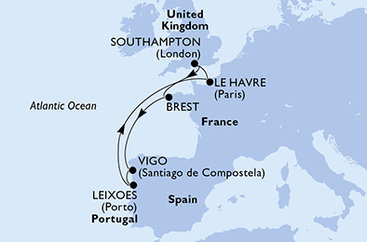
United Kingdom, France, Spain, Portugal from Southampton na lodi MSC Meraviglia
| Ship: | MSC Meraviglia |
|---|---|
| Route: | United Kingdom, France, Spain, Portugal |
| Embarkation and disembarkation: | Southampton, United Kingdom |
| Duration: | 7 nights |

Spain, France, Germany from Tarragona na lodi MSC Magnifica
| Ship: | MSC Magnifica |
|---|---|
| Route: | Spain, France, Germany |
| Embarkation: | Tarragona, Spain |
| Disembarkation: | Warnemünde, Germany |
| Duration: | 9 nights |