


Aomori (Honshu) / Japan
On the northern coast of Japan's largest island, Honshu, lies Aomori on the shores of the bay of the same name. The capital of Aomori Prefecture in the Tohoku region has about 280,000 inhabitants.
The area of today's Aomori has been inhabited since prehistoric times, and archaeological surveys have revealed numerous remains from the Jomon period. At the beginning of the Edo period, Aomori was just a small port town, but in the first half of the 17th century, it was rebuilt and officially became a city in 1898. In 1891, Aomori was connected by rail to Tokyo and began to gain importance as the prefectural capital. In 1910, a large part of Aomori was destroyed by fire, and at the end of World War II, the city was destroyed by American bombing. After the war, Aomori became a local political and commercial center and is now a popular stop for cruise ships on their voyages along the Japanese coast.
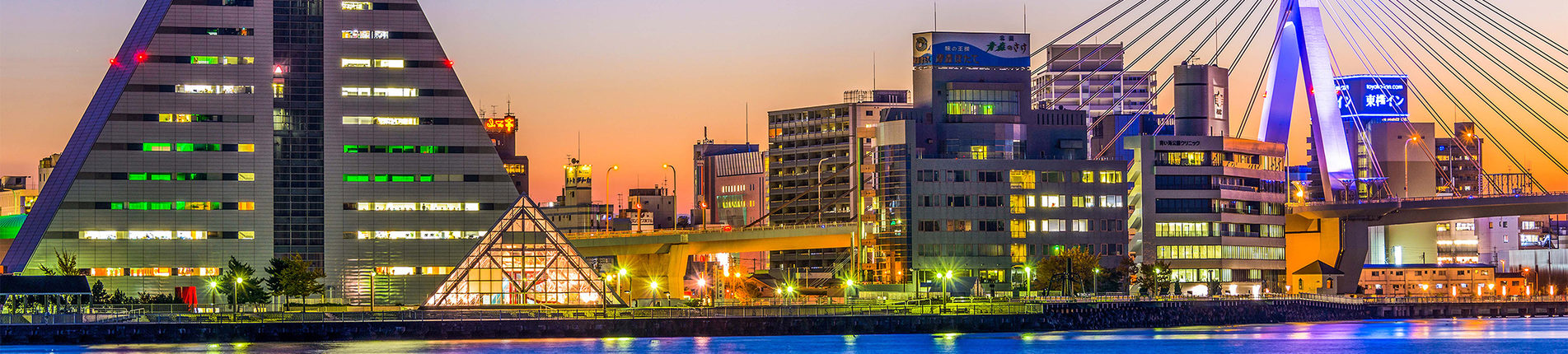
A tour of Aomori can begin at the Aspam Tourist Center, which offers not only a short film with information about the prefecture but also an observation deck with beautiful views of the city and harbor. The region is best known for its remnants of historical cultures. Southwest of the city are the Sannai-Maruyama ruins, dating back to around 4,000 BC. Storage spaces and foundations of longhouses were found here, and today visitors can view their reconstructions. The dominant feature of the Komakino site further south is an artificially constructed stone circle from around 2,000 BC.
Those who want to get acquainted with life under the sea should not miss a visit to Asamushi and the largest aquarium in the area, with 11,000 marine creatures, including many rare species from around the world.
Every year at the beginning of August, the famous Nebuta Matsuri festival takes place in Aomori. Those visiting the city outside this time can at least visit the Nebuta Warasse Museum, which is dedicated to this 300-year-old tradition.
A trip to the reconstruction of the historic Hirosaki Castle, about 40 kilometers south of Aomori, is worth it, especially during the cherry blossom season, with more than 2,500 cherry trees here. Mount Hakkoda, just half an hour's drive from the city, is a popular destination for hiking enthusiasts. Those with less time or energy can take a cable car to the top. A little further away lies the beautiful Lake Towada, enchanting mainly with its autumn colors. Those who prefer relaxation should not miss a visit to some of the many hot springs in the area, Sukayu right in the city or Asamushi to the north.
Aomori is known for its copper-colored pottery, a tradition dating back 2,000 years, as well as apple cultivation, which finds its way into many local dishes and excellent cider. Local specialties include freshly caught scallops and keno-jiru soup, containing 34 local ingredients.
Places worth seeing
Sannai-Maruyama Ruins - Take a look into the thousand-year-old history of the region at the archaeological site with reconstructions of longhouses from the Jomon period.
Nebuta Warasse Museum – Get acquainted with the 300-year-old summer festival tradition, known for its colorful lanterns of all shapes and sizes.
Seikan Ferry Memorial Ship Hakkodamaru – Don't miss the interesting museum on the former ferry, illustrating the historically main mode of transport between Honshu and neighboring Hokkaido.
Hakkoda Mountains – Take a cable car to the top of Mount Hakkoda and enjoy the beautiful views from there.
Hirosaki Castle - See the beautiful reconstruction of the historic castle and be enchanted by thousands of blooming cherry blossoms.
Asamushi Aquarium - Take a look under the surface of local and world seas in the area's largest aquarium with a variety of rare marine species.
Towada Lake – Admire the beautiful Lake Towada and its forests, popular mainly for their autumn colors.
Places worth seeing:

Třešňové květy v japonské zahradě v Hirosaki, Aomori

Pohled na centrum města Aomori v Japonsku

Hrad Hirosaky v Hirosaky v Japonsku
Cruises to Aomori:

South Korea, Japan from Seoul aboard Norwegian Jade
| Ship: | Norwegian Jade |
|---|---|
| Route: | South Korea, Japan |
| Embarkation: | Seoul, South Korea |
| Disembarkation: | Tokyo, Japan |
| Duration: | 11 nights |