


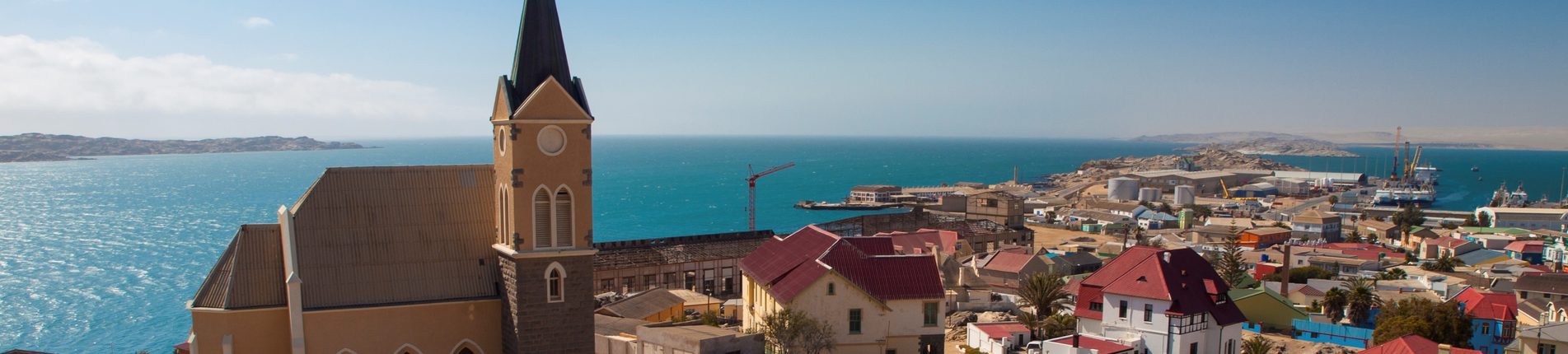
Luderitz / Namibia
In the southeastern part of Namibia, on the coast of the southern Atlantic Ocean, lies Lüderitz, a town built around the Robert Harbor and Shark Island.
The first European in the area was the Portuguese explorer and navigator Bartolomeu Dias, who landed here in the second half of the 15th century and erected a stone cross in the bay he named Angra Pequena (Little Bay). In the 19th century, whaling, seal hunting, and fishing began to develop. The town was officially founded in 1883 and was named after a German trader and founder of German South West Africa. After the discovery of diamonds in 1909, a diamond rush erupted in the area, but by 1920, mining was only taking place in areas like Pomona and Elizabeth Bay.
The town is famous for its German colonial architecture from the diamond rush era. Among the most famous buildings is the Goerkehaus, an art nouveau style house built into the rock wall of Diamond Hill. The house was constructed between 1909-11 as a private residence for the manager and co-owner of a diamond mining company. At the top of the hill, the Felsenkirche church rises to the sky, offering stunning panoramic views of the Robert Harbor. The church, in a vertical Gothic style, was consecrated in 1912, making it one of the oldest Lutheran churches in Namibia. A short visit to the railway station building from 1904 is also worthwhile.
History enthusiasts will enjoy the local museum with an exhibition focusing primarily on diamond mining, which significantly influenced Lüderitz. A major tourist attraction today is the abandoned ghost town of Kolmanskop, a former thriving mining village in the Namib Desert about 10 kilometers east of Lüderitz, which is a sought-after destination (not only) for photographers. With a guide, it is also possible to tour the reopened diamond mine in Elizabeth Bay.
The town and its surroundings boast diverse nature: here you can see colonies of seals, penguins, flamingos, or ostriches. Bird lovers will also find their place: the nearby Mercury, Ichaboe, and Halifax islands are home to the entire Namibian population of Cape gannets, endangered African penguins, and almost a quarter of the world's population of royal cormorants. Dolphin and whale watching is also not uncommon.
Those with more time can venture a little further from the town: two hours' drive south is Bogenfels, an area with a number of unique rock formations, including a 55-meter-high rock arch.
It would certainly be a mistake not to taste some of the local specialties. Among them should not be missing the excellent Namibian oysters or lobster, for which a special festival is even held here.
Places worth seeing
Goerkehaus – Explore the former residence of the manager and co-owner of the diamond mines, built into the rock wall between 1909-11.
Felsenkirche – Enjoy the stunning views from one of the oldest Lutheran churches in Namibia.
Kolmanskop – Don't miss a visit to the "ghost town," a former mining village in the Namib Desert about 10 kilometers east of the town.
Point Dias – Imagine the times when Portuguese navigators arrived in the area at the end of the 15th century and erected a stone cross here.
Lüderitz Museum – Get acquainted with the fascinating history of the town, in which the discovery of diamonds at the beginning of the 20th century played a significant role.
Mercury, Ichaboe, Halifax Island – Visit the nearby islands, home to colonies of Cape gannets, rare African penguins, and royal cormorants.
Atlas Bay – Observe the seal colony, whose home is the bay just a stone's throw south of the town.